Common names from other countries
Malacostraca |
Decapoda |
Portunidae
Umwelt: Milieu / Klimazone / Tiefenbereich / Verbreitungsgebiet
Ökologie
Benthopelagisch; tiefenbereich 0 - 100 m (Ref. 132434). Tropical, preferred 24°C (Ref. 107945)
Indo-West Pacific.
Länge bei der ersten Reifung / Größe / Gewicht / Alter
Geschlechtsreife: Lm 13.1 range ? - ? cm Max length : 15.9 cm CW Männchen/unbestimmt; (Ref. 125642)
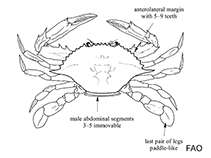
Carapace tough to granulose, regions discernible; front with 3 acutely triangular teeth; 9 teeth on each anterolateral margin, the last tooth much larger than preceding teeth. Larger chela with conical tooth at base of fingers; pollex ridged. Color: carapace dull green to brown.
Minimum depth assumed from its ecology. Shallow waters up to depths of 50 m. Inhabits sandy to sandy-muddy substrates (Ref. 343). Benthopelagic predator, feeding mainly on bivalves (Lamellibranchia), benthic crustaceans, fishes and cephalopods (Ref. 117071).
Members of the order Decapoda are mostly gonochoric. Mating behavior: Precopulatory courtship ritual is common (through olfactory and tactile cues); usually indirect sperm transfer.
Ng, P.K.L. 1998. (Ref. 343)
IUCN Rote Liste Status
(Ref. 130435: Version 2025-2 (Global))
CITES Status (Ref. 108899)
Not Evaluated
Not Evaluated
Bedrohung für Menschen
Harmless
Nutzung durch Menschen
Fischereien: kommerziell
FAO - Aquakultur: production; Fischereien: landungen, Artbeschreibung | FishSource | Das Meer um uns herum
Tools
Mehr Information
PhysiologieSauerstoffverbrauch
MenschenbezogenBriefmarken, Münzen, Verschiedenes.
Internet Quellen
Schätzungen auf der Grundlage von Modellen
Bevorzugte Temperatur
(Ref.
115969): 13.8 - 29.1, mean 28 (based on 1586 cells).
Widerstandsfähigkeit
hoch, Verdopplung der Population dauert weniger als 15 Monate. (K=0.44-1.76).
Prior r = 1.19, 95% CL = 0.79 - 1.79, Based on 2 data-limited stock assessments.
Anfälligkeit der Fischerei
Low vulnerability (10 of 100).
Klimaanfälligkeit
Low to moderate vulnerability (33 of 100).
Nutrients : Calcium = 109 [35, 184] mg/100g; Iron = 1.59 [1.21, 1.97] mg/100g; Protein = 20.2 [19.2, 21.3] %; Omega3 = 0.285 [0.185, 0.386] g/100g; Selenium = 48.3 [-31.7, 128.3] μg/100g; VitaminA = 0 μg/100g; Zinc = 1.79 [1.17, 2.40] mg/100g (wet weight); based on
nutrient studies.