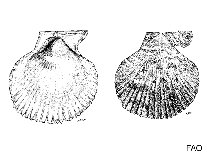
Common names from other countries
Bivalvia |
Pectinida |
Pectinidae
Miljö: miljö / Klimatzon / djupintervall / distributionsområde
Ekologi
Benthic; djupintervall 5 - 170 m (Ref. 114137). Subtropical, preferred 17°C (Ref. 107945); 35°S - 47°S, 46°W - 176°W
Southwest Pacific: Endemic to New Zealand, from Kawau Island down to Stewart Island and east to Chatham Island.
Längd vid första mognad / Storlek / Vikt / Ålder
Könsmognad: Lm 6.0, range 5 - 5.9 cm Max length : 14.0 cm ShL hane/ej könsbestämd; (Ref. )
Minimum depth range from Ref. 114139. Found in soft sediments. Juveniles are preyed upon by sea stars, gastropods, octopus, snapper, and large rays (Ref. 1244). Feeds on phytoplankton (Ref. 114780).
Livscykel och parningsbeteende
Könsmognad | Reproduktion | Lek | Ägg | Fekunditet | Larver
Members of the class Bivalvia are mostly gonochoric, some are protandric hermaphrodites. Life cycle: Embryos develop into free-swimming trocophore larvae, succeeded by the bivalve veliger, resembling a miniature clam.
SAUP Database. 2006. (Ref. 356)
Status på IUCN:s rödlista
(Ref. 130435: Version 2025-2 (Global))
CITES-status (Ref. 108899)
Not Evaluated
Not Evaluated
Hot mot människor
Mänskliga användningsområden
Fiskeri: kommersiell
FAO - fiskeri: landningar | FishSource | Havet omkring oss
Verktyg
Ytterligare information
PopulationsdynamikTillväxtMax. åldrar / storlekarLängd-vikt rel.Längd-längd rel.Längd-frekvenserMassakonverteringAbundans MänniskorelateradFrimärken, mynt, diverse.
Internet-källor
Uppskattningar baserade på modeller
Önskad temperatur
(Ref.
115969): 8.4 - 15.9, mean 13.1 (based on 64 cells).
Resiliens
Hög, lägsta populationsfördubblingstid mindre än 15 månader (K=0.58).
Prior r = 0.51, 95% CL = 0.34 - 0.76, Based on 5 data-limited stock assessments.
Sårbarhet i fisket
Low vulnerability (22 of 100).
Sårbarhet för klimatet
High vulnerability (64 of 100).
Nutrients : Calcium = 149 [71, 228] mg/100g; Iron = 8.53 [1.95, 15.11] mg/100g; Protein = 9.88 [8.64, 11.12] %; Omega3 = 0.313 [0.202, 0.423] g/100g; Selenium = 61 [50, 72] μg/100g; VitaminA = 0 μg/100g; Zinc = 2.04 [0.56, 3.51] mg/100g (wet weight); based on
nutrient studies.