Common names from other countries
Bivalvia |
Myida |
Myidae
Environnement : milieu / zone climatique / profondeur / gamme de distribution
Écologie
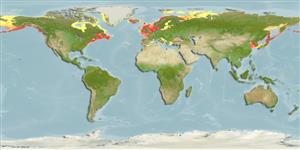
Benthic; saumâtre; profondeur 0 - 192 m (Réf. 78574), usually 0 - 25 m (Réf. 75831). Temperate, preferred 9°C (Réf. 107945); 48°N - 33°N, 79°W - 56°W
Northwest Atlantic: from St. Pierre Miquelon to North Carolina. Introduced in the North Sea and European waters including the Black, Baltic, Wadden, White and Mediterranean seas, and Eastern Pacific from Alaska to San Francisco.
Longueur à la première maturité / Taille / Poids / Âge
Maturité: Lm ? range ? - ? cm Max length : 10.0 cm TL mâle / non sexé; (Réf. 7726); âge max. reporté: 8 années (Réf. 2823)
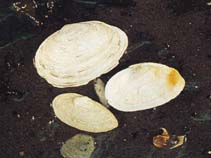
Minimum depth from Ref. 101279. Maximum depth recorded is 329 m (Ref. 101279). Lives in burrows in sand, mud, sandy mud and sandy gravels from the mid shore to the shallow sublittoral, sometimes to a depth of 192 m (Refs. 78574, 137850). Commonly found in estuarine areas, buried in substrate 10 to 20 cm deep (Ref. 95344). In the Vainameri (north-eastern Baltic Sea), abundant in silty substrate (Ref. 95753). Deposit/filter feeders (Ref. 95728). Identified as an ecologically important benthic species of the Baltic Sea, mainly as part of the food base of fishes and its contribution to biofiltration and biosedimentation processes (Ref. 95774). A microvore that feeds on organic detritus (Ref. 96352). Found both in intertidal mudflat and estuary (Refs. 2823, 137850).
Cycle de vie et comportement reproducteur
Maturité | Reproduction | Frai | Œufs | Fécondité | Larves
Members of the class Bivalvia are mostly gonochoric, some are protandric hermaphrodites. Life cycle: Embryos develop into free-swimming trocophore larvae, succeeded by the bivalve veliger, resembling a miniature clam.
Harvey-Clark, C. 1997. (Réf. 7726)
Statut dans la liste rouge de l'IUCN
(Réf. 130435: Version 2025-2 (Global))
statut CITES (Réf. 108899)
Not Evaluated
Not Evaluated
Menace pour l'homme
Utilisations par l'homme
Pêcheries: commercial
FAO - Aquaculture: production; pêcheries: débarquements | FishSource | Sea Around Us
Outils
Plus d'informations
Dynamique des populations Cycle de vieReproductionMaturitéFéconditéFraiŒufsDéveloppement de l'œufLarves PhysiologieConsommation d'oxygène
Liées à l'hommeTimbres, pièces de monnaie, divers
Sources Internet
Estimations basées sur des modèles
Température préférée
(Ref.
115969): 6.4 - 14.5, mean 10.9 (based on 360 cells).
Résilience
Milieu, temps minimum de doublement de population : 1,4 à 4,4 années (K=0.14-0.48; tmax=8).
Vulnérabilité de la pêche
Moderate vulnerability (36 of 100).
Vulnérabilité climatique
Moderate to high vulnerability (51 of 100).
Nutrients : Calcium = 149 [71, 228] mg/100g; Iron = 8.53 [1.95, 15.11] mg/100g; Protein = 9.88 [8.64, 11.12] %; Omega3 = 0.313 [0.202, 0.423] g/100g; Selenium = 61 [50, 72] μg/100g; VitaminA = 0 μg/100g; Zinc = 2.04 [0.56, 3.51] mg/100g (wet weight); based on
nutrient studies.