Malacostraca |
Decapoda |
Pandalidae
البيئة: الوسط / المنطقة المناخية / نطاق العمق / نطاق التوزيع
البيئة
قاعية التغذية و المعيشة; نطاق العمق 96 - 500 m (مرجع 105206), usually 96 - 142 m (مرجع 114245). Tropical; 34°N - 9°S, 120°W - 77°W
Eastern Pacific: Palos Verde, California to Salaverry, Peru, and Galapagos Island.
الطول عند النضج الأول / الحجم / وزن / العمر
النضج: Lm ? range ? - ? cmCommon length : 1.5 cm CL ذكر/ مختلط الجنس; (مرجع 91175); common length :1.55 cm CL (female)
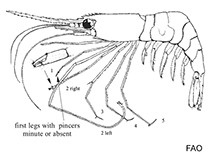
The species has a long up-curving rostrum about 1.5 time s as long as the carapace. The rostrum has 11 to 14 spines above, the first three of which on the carapace are in front of the orbit and in rapidly ascending height, and form a group separated from the others by a short space. The group of three are sutured at the base and moveable. The others on the rostrum are not sutured but are fixed spines in an almost equidistant series. One sub apical spine is separated fro m the others by a space almost one-half the length of the rostrum. Ventrally on the rostrum are 10 to 18 closely spaced and fixed spines progressively mo re separated distally. The integument of the carapace appears to be minutely pitted, although no scales were seen. The antennal spine is very strong and has a low rounded carina. The pterygostomian spine is small. Laterally on the carapace is a low curving ridge extending from
near the orbit to near the posterior edge. Beside and above the ridge in the hepatic region is one oval depression and two others below the ridge. There is also a faint impression of a cervical groove dorsally. The abdomen has no dorsal spines on any of the tergites but the area of muscle attachment dorsally on the second and third segments is deeply indented transversely. The pleura of the fourth and fifth segments are produced posteriorly, each ending in a spine. The sixth segment is not quite twice the length of the fifth and has
a spine ventrolaterally at the posterior end. The telson is slightly (one-tenth) longer than the sixth segment and has two low carinae that bear four pairs of moveable spinules, the first pair of which is separated from the others. The apex is acuminate, with a lateral pair of long spines and a median pair much smaller (less than half the length). The outer edges of the outer branches of the uropods end in a sharp projection in the axil of which is a moveable spine. A fringe of short setae is inside the edge of this branch for its entire length. The first and second pereiopods are about the same length, reaching forward just beyond the series of dorsal spines on the rostrum. The first have microscopic chelae. The second pereiopods are approximately equal to each other in size, length, etc., with 14 to 17 annulations on the carpus and with slender chelae. The third to fifth legs are longer than the first and about equal in length to each other (not quite reaching the tip of the rostrum when stretched forward), but their dactyli are unequal, decreasing in size from the third to the fifth leg. The dactylus of the fifth leg is a little more than one-half the length of the propodus. The pleopods have endopods modified according to sex: in the male the first pleopod is short, wide, and foliacious with a truncate appendix interna tipped with cinncinnuli; in the female it is long and tapering to a point and with many setae. The appendix masculina of the otherwise unmodified second pleopod is slightly longer than the appendix interna in mature males and is tipped with several long setae.
Pelagic (Ref. 105025) but also associated with soft bottoms (Ref. 91175). Preyed upon by fish (Refs. 87648, 105120). Deep-sea pandalids are reported to be active predators on planktonic organisms and/ or scavengers (Ref. 105341).
دورة الحياة وسلوك التزاوج
النضج | التكاثر | وضع البيض | بيض | الخصوبة | اليرقات
Members of the order Decapoda are mostly gonochoric. Mating behavior: Precopulatory courtship ritual is common (through olfactory and tactile cues); usually indirect sperm transfer.
Squires, H.J. and J.H. Barragan 1976 A new species of Plesionika (Crustacea, Decapoda, Pandalidae) from the Pacific Coast of Colombia. Pacific Science 30(2):113-117. (مرجع 91175)
حالة القائمة الحمراء للاتحاد الدولي لحفظ الطبيعة والموارد الطبيعية
(مرجع 130435: Version 2025-2 (Global))
حالته حسب اتفاقية سايتس (مرجع 108899)
Not Evaluated
Not Evaluated
خطر للأنسان
استخدامات بشرية
مصائد: تجاري
| FishSource | البحر حولنا
أدوات
مزيد من المعلومات
علم البيئة الغذائيةالمواد الغذائية (الفرائس)التركيبة الغذائيةاستهلاك الأغذيةمفتريسات الديناميكيات السكانيةنمو
الحد الأقصى للأعمار/الأحجام
علاقة الطول بالوزن.
علاقة الطول بالطول.
الطول- الترددات
التحويل الجماعي
الوفرة
دورة الحياةالتكاثرالنضجالخصوبةوضع البيضبيضتطور البيضةاليرقات علم وظائف الأعضاءاستهلاك الأوكسجين
ذات الصلة بالبشرطوابع بريدية وعملات معدنية ومتنوعة
مصادر علي الأنترنت
تقديرات تستند إلى النماذج
درجة الحرارة المفضلة
(Ref.
115969): 11.9 - 14.7, mean 13.8 (based on 11 cells).
Nutrients : Calcium = 109 [35, 184] mg/100g; Iron = 1.59 [1.21, 1.97] mg/100g; Protein = 20.2 [19.2, 21.3] %; Omega3 = 0.285 [0.185, 0.386] g/100g; Selenium = 48.3 [-31.7, 128.3] μg/100g; VitaminA = 0 μg/100g; Zinc = 1.79 [1.17, 2.40] mg/100g (wet weight); based on
nutrient studies.