Florideophyceae |
Ceramiales |
Rhodomelaceae
Environnement : milieu / zone climatique / profondeur / gamme de distribution
Écologie
Sessile; profondeur 0 - 19 m (Réf. 83908). Tropical
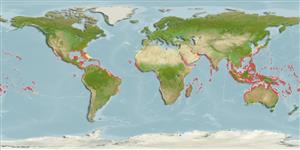
Atlantic Ocean: from USA to southeast Brazil, including Gulf of Mexico, Bermuda and the Caribbean, east to Mauritania and south to Angola, including Equatorial Guinea and São Tomé and Príncipe; Indian Ocean: from the Arabian Sea, including the Persian Gulf, Gulf of Oman, and the Red Sea, south to South Africa, including Aldabra Islands, Seychelles and Réunion, east to Sri Lanka, including Laccadive Islands and Maldives; in the Bay of Bengal, south to Dampier Archipelago, Western Australia, including Andaman and Nicobar Islands; Pacific Ocean: from China to the South China Sea, south to Lord Howe Island, including Spermonde Archipelago and Federated States of Micronesia, Solomon Islands and New Caledonia, east to the Hawaiian Islands, including Fiji, French Polynesia and the Samoan Archipelago.
Longueur à la première maturité / Taille / Poids / Âge
Maturité: Lm ? range ? - ? cm
Description synthétique
Morphologie
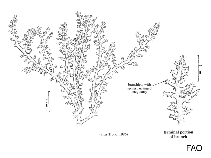
Thalli erect, loosely branched, greenish brown to purple, with a small discoid holdfast. Branches terete throughout, slightly attenuated towards the acute tips. Spinous projections, a characteristic of this genus, are densely borne on the spirally arranged determinate branchlets. Thalli to about 15 cm in height (Ref. 80758).
Used for human food consumption; also a source of lambda-carrageenan and antibiotics (Ref. 80758); of low commercial interest internationally as carrageenan sources (Ref. 82232). Maximum depth from Ref. 102170. Usually inhabits sandy-rocky areas at the lower intertidal zone where the plants are sometimes exposed to air during very low tides; found up to the upper subtidal zone and in tidepools (Ref. 80758). In Fiji, found in the high subtidal or lower intertidal zones of relatively sheltered rockflats or mudflats and sandbanks, restricted to areas where persistent low water salinity was likely to be rare; in Laucala Island, Suva Harbour, Fiji, A. spicifera were attached to rocks in the intertidal zone (Ref. 82232). Connor (1983) reported that plant size and condition of Panamanian Acanthophora decreased during the hot windless season (November-January) in combination with low tides. Small A. spicifera were found in Nasese/Nasova (near Ratu Sukuna Road junction), Suva Harbour, Fiji attached to rocks; there was abundance of A. spicifera plants in Salia Reef (navigation mark opposite Nasova Police College), attached by holdfasts to rubble and soft corals; in Kaba Peninsula, Fiji, A, spicifera plants were common on rocky areas of the intertidal, usually on the headlands along this coast and particularly within 1 km of Kaba Point itself. Along the water line of Nukusasa sandbar, Fiji were unattached fragments of A. spicifera. A lot of A. spicifera plants were growing on the rocky weather side of Tokatoka ni Kubu Reef, Fiji. Attached to rocks in deeper water at the reef's edge in Cakalevu Reef, Fiji. In the south coast of Viwa Island, Fiji, along the fringing rocky shelf, A. spicifera plants were quite common down to about 1 m depth (Ref. 82232).
Cycle de vie et comportement reproducteur
Maturité | Reproduction | Frai | Œufs | Fécondité | Larves
Guiry, M.D. and G.M. Guiry 2009 AlgaeBase. World-wide electronic publication, National University of Ireland, Galway. http://www.algaebase.org; searched on 14 April 2009. (Réf. 80701)
Statut dans la liste rouge de l'IUCN
(Réf. 130435: Version 2025-2 (Global))
statut CITES (Réf. 108899)
Not Evaluated
Not Evaluated
Menace pour l'homme
Utilisations par l'homme
Pêcheries: commercial
| FishSource |
Outils
Plus d'informations
Écologie trophiqueAliments (proies)
Composition du régime alimentaire
Consommation alimentaire
Prédateurs
Dynamique des populationsCroissanceÂges / tailles maximalesLongueur-poids rel.Rel. longueur-longueur.Fréquences de longueursConversion de masseAbondance Cycle de vieReproduction
Maturité
Fécondité
Frai
Œufs
Développement de l'œuf
Larves
PhysiologieConsommation d'oxygène
Liées à l'hommeTimbres, pièces de monnaie, divers
Sources Internet
Estimations basées sur des modèles
Température préférée
(Ref.
115969): 23.6 - 29.2, mean 27.9 (based on 5085 cells).