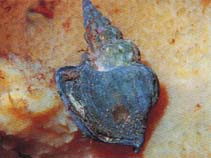
Gastropoda |
Littorinimorpha |
Aporrhaidae
สิ่งแวดล้อม : สิ่งแวดล้อม / เขตภูมิอากาศ / ระดับความลึก / ระยะการกระจายสินค้า
นิเวศวิทยา
Benthic; ระดับความลึก 4 - 1829 m (อ้างอิง 83435). Boreal; 67°N - 36°N, 79°E - 56°E (อ้างอิง 83435)
Arctic and North America.
ความยาวเมื่อครบกำหนดครั้งแรก / ขนาด / น้ำหนัก / อายุ
วัยเจริญพันธุ์: Lm ? range ? - ? cm Max length : 7.0 cm DL เพศผู้/กระเทย; (อ้างอิง 83435); common length : 5.1 cm SHL เพศผู้/กระเทย; (อ้างอิง 360)
Shell: high conical spire, rather thick and solid, with swollen whorls and very impressed sutures; outer lip is broadened and forms a large unfingered expansion; both outer and columellar lips are strongly thickened; sculpture consists of a score of strong well-spaced axial ribs, usually curving, also a spiral ornament of thin, deeply incised grooves, especially marked on the body whorl; whitish cream or grayish in color; the operculum is very small, horny and ellipsoidal, with smooth edges. Body: similar to the strombids, especially in the structure of the long and narrow foot with a smaller anterior lobe and a large posterior one that bears the operculum and enables the mollusk to leap; eyes are not pedunculated, but are at the base of the tentacles; mantle cavity contains only one gill, the osphradium and in males, the copulatory organ; radula is taenioglossan.
วงจรชีวิตและพฤติกรรมการผสมพันธุ์
วัยเจริญพันธุ์ | การสืบพันธุ์ | การวางไข่ | เซลสืบพันธ์ของเพศเมีย(ไข่) | ความดกของไข่ | ตัวอ่อน
Members of the order Neotaenioglossa are mostly gonochoric and broadcast spawners. Life cycle: Embryos develop into planktonic trocophore larvae and later into juvenile veligers before becoming fully grown adults.
Sabelli, B. and H.S. Feinberg (eds.) 1879 Simon and Schuster's Guide to Shells. Simon and Schuster's Inc. New York. 512 pp. (อ้างอิง 360)
สถานะบัญชีแดงของ IUCN
(อ้างอิง 130435: Version 2025-2 (Global))
สถานะไซเตส (อ้างอิง 108899)
Not Evaluated
CMS (อ้างอิง 116361)
Not Evaluated
ภัยคุกคามต่อมนุษย์
การใช้ของมนุษย์
| FishSource |
เครื่องมือ
ข้อมูลเพิ่มเติม
นิเวศวิทยาเขตร้อนรายการอาหาร (เหยื่อ)
องค์ประอบของอาหาร
การบริโภคอาหาร
ผู้ล่า
พลวัตของประชากรการเจริญเติบโต
อายุสูงสุด / ขนาด
ความยาว-น้ำหนักสัมพันธ์
ความยาว-ความยาวสัมพันธ์
ความยาว-ความถี่
การแปลงมวล
อุดมสมบรูณ์
วงจรชีวิตการสืบพันธุ์วัยเจริญพันธุ์ความดกของไข่การวางไข่เซลสืบพันธ์ของเพศเมีย(ไข่)การพัฒนาไข่ตัวอ่อน เกี่ยวข้องกับมนุษย์แสตมป์ เหรียญ อื่นๆ
แหล่งที่มาจากอินเตอร์เน็ต
การประมาณค่าตามแบบจำลอง
ความเสี่ยงต่อการตกปลา
Low vulnerability (10 of 100).
หมวดหมู่ราคา
Unknown.