Asteroidea |
Valvatida |
Ophidiasteridae
Milieu: milieu / Klimaatzone / Diepte / verspreidingsgebied
Ecologie
Rifbewoner; diepte 0 - 80 m (Ref. 81548). Tropical
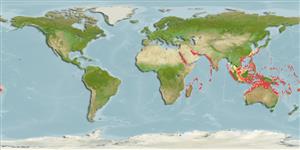
Indo-West Pacific.
Lengte bij maturiteit / Grootte / Gewicht / Leeftijd
Maturiteit: Lm ? range ? - ? cm
In Australia, it is predominant in subtidal areas (Ref. 102251). Rarely found on reef flats, lagoons and seaward reef. Cryptic. Feeds on sessile animals, algae and microbes (Ref. 102252).
Levenscyclus en paargedrag
Maturiteit | Voortplanting | Paaien | Eieren | Fecunditeit | Larven
Members of the class Asteroidea exhibit both asexual (regeneration and clonal) and sexual (gonochoric) means of reproduction. Life cycle: Embryos hatch into planktonic larvae and later metamorphose into pentamorous juveniles which develop into young sea stars with stubby arms.
Purwati, P. and D.J.W. Lane 2004 Asteroidea of the Anambas Expedition 2002. The Raffles Bulletin of Zoology 11:89-102. (Ref. 81548)
Status op de Rode Lijst van het IUCN
(Ref. 130435: Version 2025-2 (Global))
CITES status (Ref. 108899)
Not Evaluated
Not Evaluated
Gevaar voor de mens
Harmless
Gebruik door de mens
| FishSource |
Tools
Meer informatie
Trofische ecologieVoedsel (prooien)
Dieetsamenstelling
Voedselconsumptie
Predatoren
PopulatiedynamicaGroei
Max. leeftijden / maten
Lengte-gewicht rel.
Lengte-lengte rel.
Lengtefrequenties
Massaconversie
Abundantie
LevenscyclusVoortplantingMaturiteitFecunditeitPaaienEierenOntwikkeling van de eierenLarven FysiologieZuurstofverbruik
Menselijk gerelateerdPostzegels, munten, diversen.
Internetbronnen
Schattingen op basis van modellen
Gewenste temperatuur
(Ref.
115969): 24.6 - 29, mean 27.6 (based on 746 cells).