Ascidiacea |
Phlebobranchia |
Ascidiidae
Environnement : milieu / zone climatique / profondeur / gamme de distribution
Écologie
Sessile; saumâtre; profondeur 0 - 12 m (Réf. 116065). Tropical
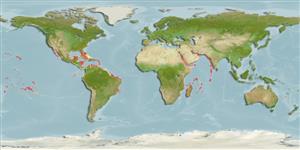
Cosmopolitan.
Longueur à la première maturité / Taille / Poids / Âge
Maturité: Lm ? range ? - ? cm Max length : 15.0 cm TL mâle / non sexé; (Réf. 86424)
Identified as a possible Lessepsian migrant, present at least in Red Sea and eastern Mediterranean (Ref. 85347). It has a wide geographical range in warm seas. Common in all habitats and it is usually surrounded by ophiurans (Ref. 415). Under rock slabs and boulders in the lower eulittoral zone and subtidal rocks. Fouls pier piles and pontoons (Ref. 102838). Commensal with amphipods (Ref. 82302).
Cycle de vie et comportement reproducteur
Maturité | Reproduction | Frai | Œufs | Fécondité | Larves
Members of the class Ascidiacea are hermaphroditic; both cross- and self-fertilization is typical. Life cycle: Eggs develop into lecithotrophic larva before metamorphosing into benthic adults.
Collin, R., M.C. Díaz, J. Norenburg, R.M. Rocha, J.A. Sánchez, M. Schulze, A. Schwartz and A. Valdés 2005 Photographic identification guide to some common marine invertebrates of Bocas Del Toro, Panama. Caribbean Journal of Science. 41(3):638-707. (Réf. 415)
Statut dans la liste rouge de l'IUCN
(Réf. 130435: Version 2025-2 (Global))
statut CITES (Réf. 108899)
Not Evaluated
Not Evaluated
Menace pour l'homme
Utilisations par l'homme
| FishSource |
Outils
Plus d'informations
Écologie trophiqueAliments (proies)
Composition du régime alimentaire
Consommation alimentaire
Prédateurs
Dynamique des populations Cycle de vieReproductionMaturitéFéconditéFraiŒufsDéveloppement de l'œufLarves PhysiologieConsommation d'oxygène
Liées à l'hommeTimbres, pièces de monnaie, divers
Sources Internet
Estimations basées sur des modèles
Température préférée
(Ref.
115969): 24.4 - 28.5, mean 27.1 (based on 494 cells).
Vulnérabilité de la pêche
Low vulnerability (10 of 100).
Catégorie de prix
Unknown.