Bivalvia |
Arcida |
Arcidae
Umwelt: Milieu / Klimazone / Tiefenbereich / Verbreitungsgebiet
Ökologie
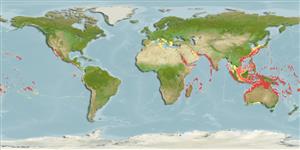
Benthic; tiefenbereich 0 - 150 m (Ref. 93550), usually 0 - 50 m (Ref. 75831). Tropical
Indo-Pacific and the Mediterranean Sea. Tropical and subtropical.
Länge bei der ersten Reifung / Größe / Gewicht / Alter
Geschlechtsreife: Lm ? range ? - ? cm Max length : 0.4 cm TL Männchen/unbestimmt; (Ref. 2922)
Found in low tidal to 130 m in crevices and stones; dead specimens to 274 m (Ref. 337); also intertidal on rocks and coral (Ref. 75831). Commonly attached via strong byssal threads to the undersides of rock slabs and boulders in the lower eulittoral subzone and to dead coral and rocks in the shallow subtidal (Ref. 102838). Also found on fine gray sand (Ref. 77792). Reported from Hong Kong to be found on the ceilings and walls of submarine caves (Ref. 126058).
Lebenszyklus und Paarungsverhalten
Geschlechtsreife | Fortpflanzung | Ablaichen | Eier | Fruchtbarkeit | Larven
Members of the class Bivalvia are mostly gonochoric, some are protandric hermaphrodites. Life cycle: Embryos develop into free-swimming trocophore larvae, succeeded by the bivalve veliger, resembling a miniature clam.
Raines, B. and M. Huber 2012 Biodiversity quadrupled - Revision of Eatser Island and Salas y Gómez bivalves. Zootaxa 3217:1-106. (Ref. 93550)
IUCN Rote Liste Status
(Ref. 130435: Version 2025-2 (Global))
CITES Status (Ref. 108899)
Not Evaluated
Not Evaluated
Bedrohung für Menschen
Harmless
Nutzung durch Menschen
| FishSource |
Tools
Mehr Information
Trophische ÖkologieLebensmittel (Beutetiere)
Nahrungszusammensetzung
Nahrungsaufnahme
Räuber
PopulationsdynamikWachstum
Max. Alter/Größen
Länge-Gewicht-Rel.
Länge-Länge-Verhältnis.
Längenhäufigkeiten
Massenkonvertierung
Dichte
LebenszyklusFortpflanzungGeschlechtsreifeFruchtbarkeitAblaichenEierEientwicklungLarven PhysiologieSauerstoffverbrauch
MenschenbezogenBriefmarken, Münzen, Verschiedenes.
Internet Quellen
Schätzungen auf der Grundlage von Modellen
Bevorzugte Temperatur
(Ref.
115969): 21.2 - 29, mean 27.4 (based on 1826 cells).
Anfälligkeit der Fischerei
Low vulnerability (10 of 100).