Gastropoda |
Not assigned |
Potamididae
Umwelt: Milieu / Klimazone / Tiefenbereich / Verbreitungsgebiet
Ökologie
Demersal; brackwasser. Tropical
Western Pacific.
Länge bei der ersten Reifung / Größe / Gewicht / Alter
Geschlechtsreife: Lm ? range ? - ? cm Max length : 3.0 cm TL Männchen/unbestimmt; (Ref. 821)
Kurzbeschreibung
Morphologie
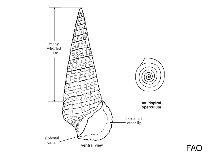
Shell of moderate size, 6 to 8 whorls, but decolate. Whorls rounded, with impressed sutures. Four shallow spiral channels present on upper whorls, and about 10 on the body whorl are crossed by axial ribs, producing numerous small nodules. Outer lip flared and slightly thickened. Shell is off white or grey, with darker spiral lines. Aperture is white. Operculum is light brown and horny.
Length based on occurence record; to be replaced with better reference. Found in sandy shores (Ref. 125338). Also found on trees and grasses in the upper intertidal portion of mangroves. Arboreal, secreting mucus to seal itself on a tree (Ref. 128877).
Lebenszyklus und Paarungsverhalten
Geschlechtsreife | Fortpflanzung | Ablaichen | Eier | Fruchtbarkeit | Larven
Members of the order Neotaenioglossa are mostly gonochoric and broadcast spawners. Life cycle: Embryos develop into planktonic trocophore larvae and later into juvenile veligers before becoming fully grown adults.
Springsteen, F.J. and F.M. Leobrera 1986 Shells of the Philippines. Carfel Seashell Museum. Metro Manila, Philippines. 377 p. (Ref. 821)
IUCN Rote Liste Status
(Ref. 130435: Version 2025-2 (Global))
CITES Status (Ref. 108899)
Not Evaluated
Not Evaluated
Bedrohung für Menschen
Nutzung durch Menschen
| FishSource |
Tools
Mehr Information
Trophische ÖkologieLebensmittel (Beutetiere)NahrungszusammensetzungNahrungsaufnahmeRäuber LebenszyklusFortpflanzungGeschlechtsreifeFruchtbarkeitAblaichenEierEientwicklungLarven PhysiologieSauerstoffverbrauch
MenschenbezogenBriefmarken, Münzen, Verschiedenes.
Internet Quellen
Schätzungen auf der Grundlage von Modellen
Anfälligkeit der Fischerei
Low vulnerability (10 of 100).