Ophiuroidea |
Amphilepidida |
Amphiuridae
Environnement : milieu / zone climatique / profondeur / gamme de distribution
Écologie
Benthic; profondeur 18 - 36 m (Réf. 81020). Subtropical
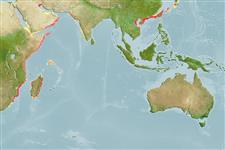
Indo-West Pacific: Madagascar and Hong Kong.
Longueur à la première maturité / Taille / Poids / Âge
Maturité: Lm ? range ? - ? cm
Cycle de vie et comportement reproducteur
Maturité | Reproduction | Frai | Œufs | Fécondité | Larves
Members of the class Ophiuroidea are mostly gonochoric, others are protandric. Fertilization is external. Brooding is common, bursae is used as brood chambers where the embryos develop into juveniles and later crawl out from the bursal slits. Life cycle: Embryos hatch into free-swimming planktotrophic larvae and later metamorphose into tiny brittle stars which sink down the bottom where they grow into adult form.
Mortensen, T. 1934 Echinoderms of Hong Kong. The Hong Kong Naturalist supplement 3:3-14. (Réf. 77931)
Statut dans la liste rouge de l'IUCN
(Réf. 130435: Version 2025-2 (Global))
statut CITES (Réf. 108899)
Not Evaluated
Not Evaluated
Menace pour l'homme
Harmless
Utilisations par l'homme
| FishSource |
Outils
Plus d'informations
Écologie trophiqueAliments (proies)
Composition du régime alimentaire
Consommation alimentaire
Prédateurs
Dynamique des populationsCroissance
Âges / tailles maximales
Longueur-poids rel.
Rel. longueur-longueur.
Fréquences de longueurs
Conversion de masse
Abondance
Cycle de vieReproductionMaturitéFéconditéFraiŒufsDéveloppement de l'œufLarves PhysiologieConsommation d'oxygène
Liées à l'hommeTimbres, pièces de monnaie, divers
Sources Internet
Estimations basées sur des modèles
Température préférée
(Ref.
115969): 24.4 - 27, mean 25.3 (based on 34 cells).