Malacostraca |
Decapoda |
Homolidae
Umwelt: Milieu / Klimazone / Tiefenbereich / Verbreitungsgebiet
Ökologie
Benthic; tiefenbereich 10 - 682 m (Ref. 62709). Tropical; 46°N - 38°S, 98°W - 37°E
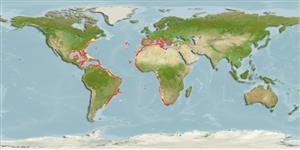
Atlantic Ocean and the Mediterranean: from USA (Massachusetts, and Virginia to south Florida), West Indies, Central America and Brazil (Rio de Janeiro to Rio Grande do Sul) to Western Africa, including Canary and Madeira Islands, to Mediterranean Sea, and northeastern Atlantic from Spain to Portugal. Temperate to tropical.
Länge bei der ersten Reifung / Größe / Gewicht / Alter
Geschlechtsreife: Lm ? range ? - ? cm Max length : 1.5 cm CW Männchen/unbestimmt; (Ref. 93549)
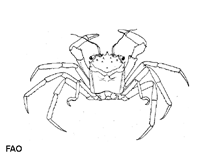
Carapace width range: 1.22 to 1.47 cm (Ref. 93549). Maximum depth from 95880. Found on moderate depths from 10 to 679 m on mud, muddy sand, sandy and muddy detritus, coralline algae, calcareous algae, slightly sandy mud with funiculines, alcyonarians in mud, and reddish gravel with shell debris (Ref. 62709). In general, members of the family Homolidae are carnivorous (Ref. 107107).
Lebenszyklus und Paarungsverhalten
Geschlechtsreife | Fortpflanzung | Ablaichen | Eier | Fruchtbarkeit | Larven
Members of the order Decapoda are mostly gonochoric. Mating behavior: Precopulatory courtship ritual is common (through olfactory and tactile cues); usually indirect sperm transfer.
Coelho Filho, P.A. 2004 Análise do macrobentos na plataforma continental externa e bancos oceânicos do nordeste do Brasil no âmbito do programa REVIZEE. Grupo de estudo do Bentos (Oceanografia Biológica), Programa REVIZEE. 81 p. (Ref. 2364)
IUCN Rote Liste Status
(Ref. 130435: Version 2025-2 (Global))
CITES Status (Ref. 108899)
Not Evaluated
Not Evaluated
Bedrohung für Menschen
Nutzung durch Menschen
| FishSource |
Tools
Mehr Information
Trophische ÖkologieLebensmittel (Beutetiere)NahrungszusammensetzungNahrungsaufnahmeRäuber PopulationsdynamikWachstumMax. Alter/GrößenLänge-Gewicht-Rel.Länge-Länge-Verhältnis.LängenhäufigkeitenMassenkonvertierungDichte LebenszyklusFortpflanzungGeschlechtsreifeFruchtbarkeitAblaichenEierEientwicklungLarven PhysiologieSauerstoffverbrauch
MenschenbezogenBriefmarken, Münzen, Verschiedenes.
Internet Quellen
Schätzungen auf der Grundlage von Modellen
Bevorzugte Temperatur
(Ref.
115969): 12.2 - 23.2, mean 15.2 (based on 354 cells).
Anfälligkeit der Fischerei
Low vulnerability (10 of 100).
Preiskategorie
Unknown.