Gastropoda |
Littorinimorpha |
Littorinidae
Umwelt: Milieu / Klimazone / Tiefenbereich / Verbreitungsgebiet
Ökologie
Benthic. Subtropical
Eastern Pacific: USA to Mexico.
Länge bei der ersten Reifung / Größe / Gewicht / Alter
Geschlechtsreife: Lm ? range ? - ? cmCommon length : 2.0 cm SHL Männchen/unbestimmt; (Ref. 312)
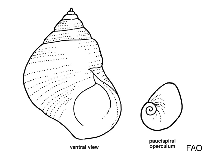
Shell has 2 whorls, and is usually eroded at tip. Purplish brown with faint white markings and a white band on the edge of the shell's mouth; smooth, flat surface next to opening. It is an important source of erosion of high intertidal cliffs (Ref. 312).
It has a shell length of 2 cm long (Ref. 312). Found in the splash and high intertidal zones. Scrapes films of diatoms, blue-green algae and green algae off rocks. When not feeding or crawling, it prevents water loss by secreting a mucous film to attach its foot to surfaces. The mucous seal and operculum (trap door), which snugly fits into the shell, are so effective that they remain alive for two or three months without being submerged under water. They need only to get their gills wet from the water's spray (Ref. 312).
Lebenszyklus und Paarungsverhalten
Geschlechtsreife | Fortpflanzung | Ablaichen | Eier | Fruchtbarkeit | Larven
Members of the order Neotaenioglossa are mostly gonochoric and broadcast spawners. Life cycle: Embryos develop into planktonic trocophore larvae and later into juvenile veligers before becoming fully grown adults.
Gallivan, G. and J. Danforth 1999 Phylum Mollusca. Marine Science Institute. (Ref. 312)
IUCN Rote Liste Status
(Ref. 130435: Version 2025-2 (Global))
CITES Status (Ref. 108899)
Not Evaluated
Not Evaluated
Bedrohung für Menschen
Nutzung durch Menschen
| FishSource |
Tools
Mehr Information
PopulationsdynamikWachstum
Max. Alter/Größen
Länge-Gewicht-Rel.
Länge-Länge-Verhältnis.
Längenhäufigkeiten
Massenkonvertierung
Dichte
LebenszyklusFortpflanzungGeschlechtsreifeFruchtbarkeitAblaichenEierEientwicklungLarven PhysiologieSauerstoffverbrauch
MenschenbezogenBriefmarken, Münzen, Verschiedenes.
Internet Quellen
Schätzungen auf der Grundlage von Modellen
Bevorzugte Temperatur
(Ref.
115969): 9.3 - 24.6, mean 11.2 (based on 223 cells).