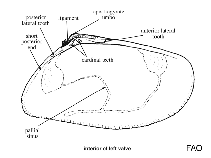
Bivalvia |
Cardiida |
Donacidae
Environnement : milieu / zone climatique / profondeur / gamme de distribution
Écologie
Benthic; saumâtre; profondeur 0 - 11 m (Réf. 83435). Subtropical; 42°N - 10°N, 98°W - 63°W
Western Atlantic: North America, from New York to Texas and Mexico, throughout the Gulf of Mexico. The Sea of Marmara and the Mediterranean: Introduced in Egypt and Turkey. Tropical to subtropical.
Longueur à la première maturité / Taille / Poids / Âge
Maturité: Lm ? range ? - ? cm Max length : 1.9 cm DL mâle / non sexé; (Réf. 83435); âge max. reporté: 1.00 années (Réf. 8702)
Found in the intertidal zone on coarse-grained (Ref. 104171) sandy beaches (Refs. 104348, 104171). Some migrate up and down the beach with the tides (Ref. 104348). Actively migrates by jumping out of the sand and riding specific waves (Ref. 104171). Filter-feeder (Ref. 104245). Feeds on phytoplankton, algae, detritus, bacteria and other small suspended particles via its short siphons (Ref. 104246).
Cycle de vie et comportement reproducteur
Maturité | Reproduction | Frai | Œufs | Fécondité | Larves
Semelparous species (Ref. 104352). Members of the class Bivalvia are mostly gonochoric, some are protandric hermaphrodites. Life cycle: Embryos develop into free-swimming trocophore larvae, succeeded by the bivalve veliger, resembling a miniature clam (Ref. 833).
Bisby, F.A., M.A. Ruggiero, K.L. Wilson, M. Cachuela-Palacio, S.W. Kimani, Y.R. Roskov, A. Soulier-Perkins and J. van Hertum 2005 Species 2000 & ITIS Catalogue of Life: 2005 Annual Checklist. CD-ROM; Species 2000: Reading, U.K. (Réf. 19)
Statut dans la liste rouge de l'IUCN
(Réf. 130435: Version 2025-2 (Global))
statut CITES (Réf. 108899)
Not Evaluated
Not Evaluated
Menace pour l'homme
Utilisations par l'homme
Pêcheries: pêcheries vivrières
| FishSource |
Outils
Plus d'informations
Dynamique des populations PhysiologieConsommation d'oxygène
Liées à l'hommeTimbres, pièces de monnaie, divers
Sources Internet
Estimations basées sur des modèles
Température préférée
(Ref.
115969): 23.4 - 28, mean 26.8 (based on 348 cells).
Vulnérabilité de la pêche
Low vulnerability (10 of 100).