Demospongiae |
Clionaida |
Clionaidae
Umwelt: Milieu / Klimazone / Tiefenbereich / Verbreitungsgebiet
Ökologie
Sessile; tiefenbereich 2 - 22 m (Ref. 108813). Tropical
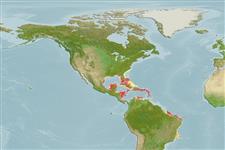
Western Central Atlantic: Caribbean and USA.
Länge bei der ersten Reifung / Größe / Gewicht / Alter
Geschlechtsreife: Lm ? range ? - ? cm
Encrusting with round to oval shaped papillae; 0.2 - 0.5 cm wide; 0.1 - 0.2 cm high excavates several cm up to 10 cm into the coral rubble (Ref. 415). Encrustations may exceed 1 m across. Smooth surface, but dense with pore-bearing, flattened, circular, wart-like papillae. Orange to red-orange exterior, often with paler oscules. Interior is red-orange to red. Soft consistency, but hard to distinguish from the substrate. Oscules circular and scattered, 0.07 to 0.1 cm across, elevated on membranous collars up to 0.15 cm (Ref. 85482).
Very common species on shallow to deeper reefs greater than 4 m deep (Ref. 415). Excavating on reefs (Ref. 85482).
Lebenszyklus und Paarungsverhalten
Geschlechtsreife | Fortpflanzung | Ablaichen | Eier | Fruchtbarkeit | Larven
Members of the class Demospongiae are hermaphroditic. Life cycle: The zygote develops into parenchymella larva (free-swimming) before settling down on a substrate where it grows into a young sponge.
Collin, R., M.C. Díaz, J. Norenburg, R.M. Rocha, J.A. Sánchez, M. Schulze, A. Schwartz and A. Valdés 2005 Photographic identification guide to some common marine invertebrates of Bocas Del Toro, Panama. Caribbean Journal of Science. 41(3):638-707. (Ref. 415)
IUCN Rote Liste Status
(Ref. 130435: Version 2025-2 (Global))
CITES Status (Ref. 108899)
Not Evaluated
Not Evaluated
Bedrohung für Menschen
Nutzung durch Menschen
| FishSource |
Tools
Mehr Information
Trophische ÖkologieLebensmittel (Beutetiere)
Nahrungszusammensetzung
Nahrungsaufnahme
Räuber
PopulationsdynamikWachstum
Max. Alter/Größen
Länge-Gewicht-Rel.
Länge-Länge-Verhältnis.
Längenhäufigkeiten
Massenkonvertierung
Dichte
LebenszyklusFortpflanzungGeschlechtsreifeFruchtbarkeitAblaichenEierEientwicklungLarven PhysiologieSauerstoffverbrauch
MenschenbezogenBriefmarken, Münzen, Verschiedenes.
Internet Quellen
Schätzungen auf der Grundlage von Modellen
Bevorzugte Temperatur
(Ref.
115969): 25.1 - 28.2, mean 27 (based on 294 cells).
Preiskategorie
Unknown.