Pycnogonida |
Pantopoda |
Pycnogonidae
Milieu: milieu / Klimaatzone / Diepte / verspreidingsgebied
Ecologie
Benthic; diepte 3 - 15 m (Ref. 860). Subtropical
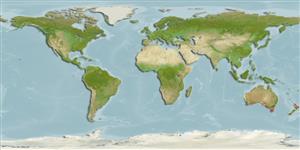
Indo-West Pacific: Australia.
Lengte bij maturiteit / Grootte / Gewicht / Leeftijd
Maturiteit: Lm ? range ? - ? cm
Trunk with post-ocular tubercle, segments 1 - 3 with raised transverse ridges each with blunt dorsomedian tubercle. Ovigers absent, both sexes. Dorsal reticulations obscure or absent. All leg segments tuberculate dorsally, propodus longest segment, sole spines distally cleft, auxiliary claws absent (Ref. 860).
3 to 15 m in depth (Ref. 860).
Levenscyclus en paargedrag
Maturiteit | Voortplanting | Paaien | Eieren | Fecunditeit | Larven
Members of the class Pycnogonida are gonochoric and sexually dimorphic. During copulation, male usually suspends itself beneath the female. Fertilization occurs as the eggs leave the female's ovigers. Males brood the egg masses until they hatch. Life cycle: Eggs hatch into protonymphon larva then to adults.
Staples, D.A. 2002 Pycnogonum (Pycnogonida: Pycnogonidae) from Australia with descriptions of two new species. Memoirs of the Museum of Victoria 59 (2):541-553. (Ref. 860)
Status op de Rode Lijst van het IUCN
(Ref. 130435: Version 2025-2 (Global))
CITES status (Ref. 108899)
Not Evaluated
Not Evaluated
Gevaar voor de mens
Gebruik door de mens
| FishSource |
Tools
Meer informatie
Trofische ecologieVoedsel (prooien)
Dieetsamenstelling
Voedselconsumptie
Predatoren
PopulatiedynamicaGroei
Max. leeftijden / maten
Lengte-gewicht rel.
Lengte-lengte rel.
Lengtefrequenties
Massaconversie
Abundantie
LevenscyclusVoortplantingMaturiteitFecunditeitPaaienEierenOntwikkeling van de eierenLarven FysiologieZuurstofverbruik
Menselijk gerelateerdPostzegels, munten, diversen.
Internetbronnen
Schattingen op basis van modellen
Gewenste temperatuur
(Ref.
115969): 14.6 - 19.1, mean 17.4 (based on 222 cells).
Prijsklasse
Unknown.