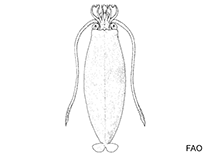
Cephalopoda |
Oegopsida |
Cranchiidae | Taoniinae
Environment: milieu / climate zone / depth range / distribution range
Ecology
Demersal; depth range 1600 - 2400 m (Ref. 78698). Subtropical
Indo-Pacific, Antarctic Indian Ocean and the Atlantic: Narrow circumglobal band in the region of the Southern Subtropical convergence about 40° S.
Length at first maturity / Size / Weight / Age
Maturity: Lm ? range ? - ? cm Max length : 21.0 cm ML male/unsexed; (Ref. 122361)
Life cycle and mating behavior
Maturity | Reproduction | Spawning | Eggs | Fecundity | Larvae
Members of the class Cephalopoda are gonochoric. Male and female adults usually die shortly after spawning and brooding, respectively. Mating behavior: Males perform various displays to attract potential females for copulation. During copulation, male grasp the female and inserts the hectocotylus into the female's mantle cavity where fertilization usually occurs. Life cycle: Embryos hatch into planktonic stage and live for some time before they grow larger and take up a benthic existence as adults.
Bisby, F.A., M.A. Ruggiero, K.L. Wilson, M. Cachuela-Palacio, S.W. Kimani, Y.R. Roskov, A. Soulier-Perkins and J. van Hertum 2005 Species 2000 & ITIS Catalogue of Life: 2005 Annual Checklist. CD-ROM; Species 2000: Reading, U.K. (Ref. 19)
IUCN Red List Status
(Ref. 130435: Version 2025-2 (Global))
CITES status (Ref. 108899)
Not Evaluated
Not Evaluated
Threat to humans
Human uses
| FishSource |
Tools
More information
Trophic EcologyFood items (preys)Diet compositionFood consumptionPredators Population dynamicsGrowthMax. ages / sizesLength-weight rel.Length-length rel.Length-frequenciesMass conversionAbundance Life cycleReproductionMaturityFecunditySpawningEggsEgg developmentLarvae PhysiologyOxygen consumption
Human RelatedStamps, coins, misc.
Internet sources
Estimates based on models
Preferred temperature
(Ref.
115969): 1.8 - 3.2, mean 2.6 (based on 379 cells).
Fishing Vulnerability
Low vulnerability (11 of 100).