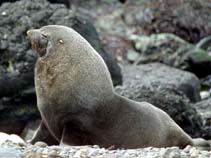
Mammalia |
Carnivora |
Otariidae
Environment: milieu / climate zone / depth range / distribution range
Ecology
Bathydemersal. Temperate; 0°N - 90°S, 78°W - 165°E
Indo-Pacific, Atlantic Ocean and the Antarctic: Antarctic Zone of South Atlantic, Indian and western South Pacific sectors of Southern ocean. Tropical to polar.
Length at first maturity / Size / Weight / Age
Maturity: Lm ? range ? - ? cm Max length : 200 cm TL male/unsexed; (Ref. 1394); 140 cm TL (female); max. published weight: 230.0 kg (Ref. 1394); max. published weight: 230.0 kg
Prefers rocky habitats; haul out on sandy beaches and move into such vegetation as tussock grass; found out to sea. In winter, males and subadults occur south to the edge of the consolidated pack ice, and can be found haled out on sea ice. Feeds on krill and fish. They prefer rocky habitats; haul out on sandy beaches and move into such vegetation as tussock grass; found out to sea; In winter, males and subadults occur south to the edge of the consolidated pack ice, and can be found haled out on sea ice. Feeds on krill and fish (Ref. 1394).
Life cycle and mating behavior
Maturity | Reproduction | Spawning | Eggs | Fecundity | Larvae
Jefferson, T.A., S. Leatherwood and M.A. Webber 1993 FAO species Identification Guide: Marine Mammals of the World. Rome, FAO. 320 p. + 587 figures. (Ref. 1394)
IUCN Red List Status
(Ref. 130435: Version 2025-2 (Global))
CITES status (Ref. 108899)
Not Evaluated
Threat to humans
Human uses
Fisheries: commercial
FAO - Fisheries: species profile | FishSource | Sea Around Us
Tools
More information
Life cycleReproduction
Maturity
Fecundity
Spawning
Eggs
Egg development
Larvae
PhysiologyOxygen consumption
Human RelatedStamps, coins, misc.
Internet sources
Estimates based on models
Preferred temperature
(Ref.
115969): -1.1 - 6.3, mean 2 (based on 688 cells).
Resilience
Medium, minimum population doubling time 1.4 - 4.4 years (K=0.13-0.44).
Fishing Vulnerability
High to very high vulnerability (72 of 100).
Price category
Unknown.