Florideophyceae |
Gracilariales |
Gracilariaceae
Environnement : milieu / zone climatique / profondeur / gamme de distribution
Écologie
Sessile. Tropical
Pacific Ocean: Philippines.
Longueur à la première maturité / Taille / Poids / Âge
Maturité: Lm ? range ? - ? cm
Description synthétique
Morphologie
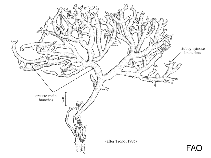
Thalli reddish brown to purple in colour, erect, loosely branched, attached to shells and debris by a very small discoid holdfast. Branches 0.8 to 1.9 mm in diameter, terete throughout, slender, gradually tapering towards filiform apices, distinctly constricted at the base; soft and easily broken when fresh. Cortex composed of 1 or 2 layers of spherical to cuboidal cells, 9x4.75 to 13x8.25 μm in size. Medullary cells large, 52 to 746 μm in diameter; cell walls 3 to 4.5 μm thick; cell size transition from medulla to cortex abrupt. Cystocarps semi-globose, unconstricted at the base and distributed on more mature branches, 0.8 to 0.9 mm in diameter. Pericarp consisting of 6 to 10 layers of cells, 103 to 188 μm thick; outermost cells round to oval and anticlinally arranged, inner layers periclinally arranged, becoming flattened towards the gonimoblast. Nutritive filaments abundant between pericarp and gonimoblast. Carpospores 15 to 20 μm in diameter, gonimoblast centre composed of few large parenchyma cells. Spermatangial cavities oval, cup-shaped to deep oval (verrucosa type) and 36.5 to 104 μm deep. Tetraspores prominent, sometimes protruding from the cortex, 26.26x18 to 39.25x31.75 μm in size. Thalli up to 54 cm in length (Ref. 80758).
Consumed by humans as food and as raw material for agar manufacture (Ref. 80758). Grows attached to pebbles, shells and stones on muddy bottoms in shallow nutrient-rich water (Ref. 80758).
Cycle de vie et comportement reproducteur
Maturité | Reproduction | Frai | Œufs | Fécondité | Larves
Guiry, M.D. and G.M. Guiry 2009 AlgaeBase. World-wide electronic publication, National University of Ireland, Galway. http://www.algaebase.org; searched on 14 April 2009. (Réf. 80701)
Statut dans la liste rouge de l'IUCN
(Réf. 130435: Version 2025-2 (Global))
statut CITES (Réf. 108899)
Not Evaluated
Not Evaluated
Menace pour l'homme
Utilisations par l'homme
Pêcheries: commercial
| FishSource |
Outils
Plus d'informations
Écologie trophiqueAliments (proies)
Composition du régime alimentaire
Consommation alimentaire
Prédateurs
Dynamique des populationsCroissance
Âges / tailles maximales
Longueur-poids rel.
Rel. longueur-longueur.
Fréquences de longueurs
Conversion de masse
Abondance
Cycle de vieReproduction
Maturité
Fécondité
Frai
Œufs
Développement de l'œuf
Larves
PhysiologieConsommation d'oxygène
Liées à l'hommeTimbres, pièces de monnaie, divers
Sources Internet
Estimations basées sur des modèles