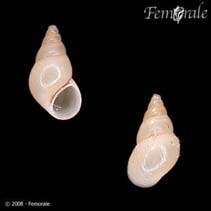
Gastropoda |
Littorinimorpha |
Hydrobiidae
Environnement : milieu / zone climatique / profondeur / gamme de distribution
Écologie
Benthic; eau douce; saumâtre; profondeur 4 - 45 m (Réf. 115293). Temperate
Southwest Pacific and Northeast Atlantic.
Longueur à la première maturité / Taille / Poids / Âge
Maturité: Lm ? range ? - ? cm
This species is a surface detritivore (Ref. 95728). Deposit feeder, ingesting sediment particles (Ref. 115292). Abundant herbivores of freshwater littoral zones (Ref. 115285), feeding on microalgae. Omnivorous (Ref. 115284).
Cycle de vie et comportement reproducteur
Maturité | Reproduction | Frai | Œufs | Fécondité | Larves
Members of the order Neotaenioglossa are mostly gonochoric and broadcast spawners. Life cycle: Embryos develop into planktonic trocophore larvae and later into juvenile veligers before becoming fully grown adults.
Healy, B. 1997 Long-term changes in a brackish lagoon, Lady's Island Lake, South-east Ireland. Biology and Environment: Proceedings of the Royal Irish Academy. 97B(1):33-51. (Réf. 2779)
Statut dans la liste rouge de l'IUCN
(Réf. 130435: Version 2025-2 (Global))
statut CITES (Réf. 108899)
Not Evaluated
Not Evaluated
Menace pour l'homme
Utilisations par l'homme
| FishSource |
Outils
Plus d'informations
Dynamique des populations PhysiologieConsommation d'oxygène
Liées à l'hommeTimbres, pièces de monnaie, divers
Sources Internet
Estimations basées sur des modèles
Résilience
Faible, temps minimum de doublement de population : 4,5 à 14 années (Fec=37).
Catégorie de prix
Unknown.