Malacostraca |
Amphipoda |
Lysianassidae
Entorno: milieu / zona climática / rango de profundidad / gama de distribución
Ecología
Batipelágico; rango de profundidad 0 - 800 m (Referencia 84663). Deep-water
Distribución
Territories | Áreas FAO | Ecosistemas | Ocurrencias, apariciones | Introducciones
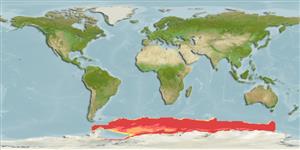
Southern Ocean: East and West Antarctic and South Georgia provinces.
Longitud en la primera madurez / Tamaño / Peso / Edad
Madurez: Lm ? range ? - ? cm
Inhabits bathyal zone from 13 to 385 m and pelagic zone from 0 to 800 m (Ref. 84663).
Ciclo vital y comportamiento de apareamiento
Madurez | Reproducción | Puesta | Huevos | Fecundidad | Larva
Members of the order Amphipoda are gonochoric and sexually dimoprhic (males larger than females). Mating behavior: Males locate potential partners with the aid of their antenna to detect the pheromones released by the females; the male then rides or carries the female until the latter is ready to molt. When the female is ready, the male pushes the sperm into the marsupium and releases the female afterwards. A few hours later, the female releases her eggs into the marsupium for fertilization. Life cycle: Eggs are brooded in the marsupium. Eggs hatch into juveniles and remain in the marsupium for a few days. Each species undergo 20 molts at most, i.e., 1-year long life cycle.
De Broyer, C., J.K. Lowry, K. Jazdzewski and H. Robert 2007 Catalogue of the Gammaridean and Corophiidean Amphipoda (Crustacea) of the Southern Ocean, with distribution and ecological data. In C. De Broyer (ed.), Census of Antarctic Marine Life: Synopsis of the Amphipoda of the Southern Ocean. Vol. I. Bulletin de l'Institut royal des Sciences naturelles de Belgique van het koninklijk Belgisch Instituut voor Natuurwetenschappen. Biologie 77(suppl.1):1-325. (Referencia 84663)
Situación en la Lista Roja de la UICN
(Referencia 130435: Version 2025-2 (Global))
Estatus CITES (Referencia 108899)
Not Evaluated
CMS (Referencia 116361)
Not Evaluated
Amenaza para el ser humano
Harmless
Usos humanos
| FishSource |
Herramientas
Más información
Ecología TróficaAlimentos (presas)
Composición de la dieta
consumo de alimento
Despredadores
Dinámica de la poblaciónCrecimiento
Edades / tallas máximas
Longitud-peso rel.
Longitud-longitud rel.
Longitud-frecuencias
Conversión de masas
Abundancia
Ciclo de vidaReproducciónMadurezFecundidadPuestaHuevosDesarrollo de los huevosLarva FisiologíaConsumo del oxígeno
Relacionados con el ser humanoSellos, monedas, varios
Fuentes de Internet
Estimaciones basadas en modelos
Temperatura preferida
(Ref.
115969): -1.6 - 1, mean -0.8 (based on 170 cells).