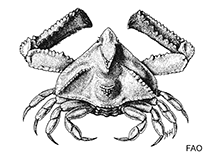
Malacostraca |
Decapoda |
Parthenopidae
Milieu: milieu / Klimaatzone / Diepte / verspreidingsgebied
Ecologie
Benthic; diepte 15 - 200 m (Ref. 125642). Subtropical; 42°N - 28°S, 103°E - 171°E
Central and Eastern Indo-Pacific: from Singapore to Samoa in the east, north to Japan and Korea and south to Moreton Bay, Australia. Subtropical to temperate climates.
Lengte bij maturiteit / Grootte / Gewicht / Leeftijd
Maturiteit: Lm ? range ? - ? cm Max length : 8.2 cm BL mannelijk / geslacht onbekend; (Ref. 83447); 7.7 cm BL (female)
Inshore, subtidal on hard bottom (Ref. 106854). Host to the barnacle Balanus socialis (Ref. 105333). Highly mobile predator (Ref. 114575).
Levenscyclus en paargedrag
Maturiteit | Voortplanting | Paaien | Eieren | Fecunditeit | Larven
Members of the order Decapoda are mostly gonochoric. Mating behavior: Precopulatory courtship ritual is common (through olfactory and tactile cues); usually indirect sperm transfer.
Hong, S.Y., K.Y. Park, C.W. Park, C.H. Han, H.L. Suh, S.G. Yun, C.B. Song, S.G. Jo, H.S. Lim, Y.S. Kang, D.J. Kim, C.W. Ma, M.H. Son, H.K. Cha, K.B. Kim, S.D. Choi, K.Y. Park, C.W. Oh, D.N. Kim, H.S. Shon, J.N. Kim et al. 2006 Marine invertebrates in Korean coasts. Republic of Korea, Academy Publishing Company, Inc. 479 p. (Ref. 83447)
Status op de Rode Lijst van het IUCN
(Ref. 130435: Version 2025-2 (Global))
CITES status (Ref. 108899)
Not Evaluated
Not Evaluated
Gevaar voor de mens
Harmless
Gebruik door de mens
Visserij: commercieel
| FishSource | Sea Around Us
Tools
Meer informatie
Trofische ecologieVoedsel (prooien)
Dieetsamenstelling
Voedselconsumptie
Predatoren
LevenscyclusVoortplantingMaturiteitFecunditeitPaaienEierenOntwikkeling van de eierenLarven FysiologieZuurstofverbruik
Menselijk gerelateerdPostzegels, munten, diversen.
Internetbronnen
Schattingen op basis van modellen
Gewenste temperatuur
(Ref.
115969): 12.1 - 24.2, mean 20.6 (based on 48 cells).
Kwetsbaarheid van de visserij
Low vulnerability (10 of 100).
Nutrients : Calcium = 109 [35, 184] mg/100g; Iron = 1.59 [1.21, 1.97] mg/100g; Protein = 20.2 [19.2, 21.3] %; Omega3 = 0.285 [0.185, 0.386] g/100g; Selenium = 48.3 [-31.7, 128.3] μg/100g; VitaminA = 0 μg/100g; Zinc = 1.79 [1.17, 2.40] mg/100g (wet weight); based on
nutrient studies.