Bivalvia |
Venerida |
Veneridae
Environnement : milieu / zone climatique / profondeur / gamme de distribution
Écologie
Benthic. Temperate
Endemic to southern Australia and Tasmania.
Longueur à la première maturité / Taille / Poids / Âge
Maturité: Lm ? range ? - ? cmCommon length : 5.1 cm SHL mâle / non sexé; (Réf. 360)
Description synthétique
Morphologie
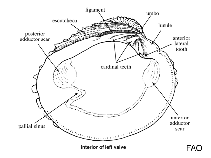
Shell: delicate, moderately swollen, equivalve and inequilateral, yellowish-whitish in color; sculpture has thin pink concentric lamellae, well-spaced, curve, grooved on the outer surface, prolonged posteriorly to form a spoutlike process; in between lamellae are thin growth lines; very longe ligament deeply set in the dorsal margin runs from the umbones to the end of the hinge which is heterodont with only three cardinal teeth on each valve; muscle scars almost equal (dimyarian, isomyarian); Pallial line has a shallow sinus (sinopalliate). Body: pair of gills each has two series of lamellae extensively fused in interlamellar junctions (eulamellabranch); foot and siphon moderately developed.
Cycle de vie et comportement reproducteur
Maturité | Reproduction | Frai | Œufs | Fécondité | Larves
Members of the class Bivalvia are mostly gonochoric, some are protandric hermaphrodites. Life cycle: Embryos develop into free-swimming trocophore larvae, succeeded by the bivalve veliger, resembling a miniature clam.
Sabelli, B. and H.S. Feinberg (eds.) 1879 Simon and Schuster's Guide to Shells. Simon and Schuster's Inc. New York. 512 pp. (Réf. 360)
Statut dans la liste rouge de l'IUCN
(Réf. 130435: Version 2025-2 (Global))
statut CITES (Réf. 108899)
Not Evaluated
Not Evaluated
Menace pour l'homme
Harmless
Utilisations par l'homme
| FishSource |
Outils
Plus d'informations
Écologie trophiqueAliments (proies)
Composition du régime alimentaire
Consommation alimentaire
Prédateurs
Dynamique des populationsCroissance
Âges / tailles maximales
Longueur-poids rel.
Rel. longueur-longueur.
Fréquences de longueurs
Conversion de masse
Abondance
Cycle de vieReproductionMaturitéFéconditéFraiŒufsDéveloppement de l'œufLarves PhysiologieConsommation d'oxygène
Liées à l'hommeTimbres, pièces de monnaie, divers
Sources Internet
Estimations basées sur des modèles