Ophiuroidea |
Ophiacanthida |
Ophiodermatidae
Milieu: milieu / Klimaatzone / Diepte / verspreidingsgebied
Ecologie
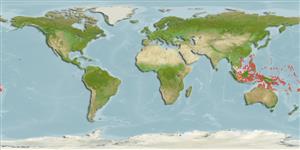
Benthic; diepte 0 - 26 m (Ref. 81020). Tropical
Indo-West Pacific.
Lengte bij maturiteit / Grootte / Gewicht / Leeftijd
Maturiteit: Lm ? range ? - ? cm
Levenscyclus en paargedrag
Maturiteit | Voortplanting | Paaien | Eieren | Fecunditeit | Larven
Members of the class Ophiuroidea are mostly gonochoric, others are protandric. Fertilization is external. Brooding is common, bursae is used as brood chambers where the embryos develop into juveniles and later crawl out from the bursal slits. Life cycle: Embryos hatch into free-swimming planktotrophic larvae and later metamorphose into tiny brittle stars which sink down the bottom where they grow into adult form.
Fujita, T., Z.B. Yasin and A.T.S. Hwai 2008 Preliminary list of shallow-water ophiuoroids (Echinodermata) collected from the Tioman Islands, in the South China Sea, Malaysia. Memoirs of the Natural Museum of Nature and Science 45:1-11. (Ref. 84821)
Status op de Rode Lijst van het IUCN
(Ref. 130435: Version 2025-2 (Global))
CITES status (Ref. 108899)
Not Evaluated
Not Evaluated
Gevaar voor de mens
Harmless
Gebruik door de mens
| FishSource |
Tools
Meer informatie
Trofische ecologieVoedsel (prooien)
Dieetsamenstelling
Voedselconsumptie
Predatoren
PopulatiedynamicaGroei
Max. leeftijden / maten
Lengte-gewicht rel.
Lengte-lengte rel.
Lengtefrequenties
Massaconversie
Abundantie
LevenscyclusVoortplantingMaturiteitFecunditeitPaaienEierenOntwikkeling van de eierenLarven FysiologieZuurstofverbruik
Menselijk gerelateerdPostzegels, munten, diversen.
Internetbronnen
Schattingen op basis van modellen
Gewenste temperatuur
(Ref.
115969): 28.4 - 29.4, mean 28.9 (based on 958 cells).