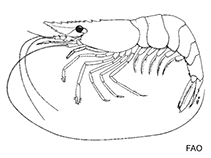
Malacostraca |
Decapoda |
Palaemonidae
Environnement : milieu / zone climatique / profondeur / gamme de distribution
Écologie
Benthopélagique; saumâtre; profondeur 3 - 740 m (Réf. 105050). Tropical; 16°N - 17°S, 18°W - 14°E
Eastern Atlantic: along West African coast, from Senegal to Angola.
Longueur à la première maturité / Taille / Poids / Âge
Maturité: Lm ? range ? - ? cm Max length : 7.5 cm TL mâle / non sexé; (Réf. 434)
Pelagic (Ref. 105112). Exploited in the continental shelf (Ref. 121688). Inshore, prefers high salinity river mouths (Ref. 121669). Also found on sandy and muddy bottoms in estuarine and coastal marine waters to depths of about 50 m (Ref. 434). Mainly feeds on mysids and copepods. Preyed upon by fish and decapods (Ref. 105112).
Cycle de vie et comportement reproducteur
Maturité | Reproduction | Frai | Œufs | Fécondité | Larves
Members of the order Decapoda are mostly gonochoric. Mating behavior: Precopulatory courtship ritual is common (through olfactory and tactile cues); usually indirect sperm transfer.
Fischer, W., G. Bianchi and W.B. Scott (eds.) 1981 Shrimps and prawns. 6: pag.var. In FAO species identification sheets for fishery purposes. Eastern Central Atlantic (Fishing Area 34, 47; in part). Canada Funds-in-Trust. Ottawa, Department of Fisheries and Oceans Canada, by arrangement with the Food and Agriculture organization of the United Nations. 1-7: pag.var. (Réf. 434)
Statut dans la liste rouge de l'IUCN
(Réf. 130435: Version 2025-2 (Global))
statut CITES (Réf. 108899)
Not Evaluated
Not Evaluated
Menace pour l'homme
Utilisations par l'homme
Pêcheries: commercial
FAO - pêcheries: débarquements | FishSource |
Outils
Plus d'informations
Dynamique des populations Cycle de vieReproductionMaturitéFéconditéFraiŒufsDéveloppement de l'œufLarves PhysiologieConsommation d'oxygène
Liées à l'hommeTimbres, pièces de monnaie, divers
Sources Internet
Estimations basées sur des modèles
Température préférée
(Ref.
115969): 11 - 16.4, mean 14.2 (based on 40 cells).
Vulnérabilité de la pêche
Low vulnerability (10 of 100).