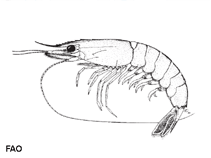
Malacostraca |
Decapoda |
Penaeidae
Milieu: milieu / Klimaatzone / Diepte / verspreidingsgebied
Ecologie
Benthic; brak water; diepte 5 - 90 m (Ref. 8), usually ? - 20 m (Ref. 346). Tropical; 40°N - 11°S, 61°E - 143°E
Indo-West Pacific: Pakistan to Japan and Borneo.
Lengte bij maturiteit / Grootte / Gewicht / Leeftijd
Maturiteit: Lm ?, range 7 - ? cm Max length : 13.5 cm TL (female)
Found from the coastline to depths of about 90 m. On mud bottom, sandy-mud or sand. Juveniles mainly inhabit estuaries and backwaters (Ref. 346). Juveniles also found in intertidal and subtidal edge of mud flats, near inshore and far inshore waters (Ref. 121464). In general, the majority of penaeids are omnivorous or detritus feeders (Ref. 105082). Benthic feeder (Ref. 114818).
Members of the order Decapoda are mostly gonochoric. Mating behavior: Precopulatory courtship ritual is common (through olfactory and tactile cues); usually indirect sperm transfer.
Holthuis, L.B. 1980 FAO Species Catalogue. Vol. 1. Shrimps and prawns of the world. An annotated catalogue of species of interest to fisheries. FAO Fish. Synop. 125(1):271 p. Rome: FAO. (Ref. 8)
Status op de Rode Lijst van het IUCN
(Ref. 130435: Version 2025-2 (Global))
CITES status (Ref. 108899)
Not Evaluated
Not Evaluated
Gevaar voor de mens
Gebruik door de mens
Visserij: commercieel
| FishSource | Sea Around Us
Tools
Meer informatie
Trofische ecologieVoedsel (prooien)
Dieetsamenstelling
Voedselconsumptie
Predatoren
FysiologieZuurstofverbruik
Menselijk gerelateerdPostzegels, munten, diversen.
Internetbronnen
Schattingen op basis van modellen
Gewenste temperatuur
(Ref.
115969): 14.2 - 29.2, mean 28.4 (based on 354 cells).
Weerstandsvermogen
Hoog, minimale populatieverdubbelingstijd minder dan 15 maanden (K=0.45-1.7).
Kwetsbaarheid van de visserij
Low vulnerability (10 of 100).
Nutrients : Calcium = 109 [35, 184] mg/100g; Iron = 1.59 [1.21, 1.97] mg/100g; Protein = 20.2 [19.2, 21.3] %; Omega3 = 0.285 [0.185, 0.386] g/100g; Selenium = 48.3 [-31.7, 128.3] μg/100g; VitaminA = 0 μg/100g; Zinc = 1.79 [1.17, 2.40] mg/100g (wet weight); based on
nutrient studies.