Merostomata |
Xiphosura |
Limulidae
Окружающая среда: среда / климатическая зона / пределы глубины / диапазон распространения
экология
Benthic; пределы глубины 3 - 290 m (ссылка 137822). Tropical, preferred 24°C (ссылка 107945); 44°N - 18°N, 93°W - 66°W
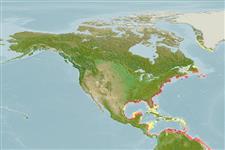
Western Atlantic: Known from the Gulf of Maine to Florida, USA and along the coast of the Gulf of Mexico from Florida to the Yucatan Peninsula, but absent from the western and southern Gulf of Mexico (from Texas, USA to Tabasco, Mexico). Introduced in Northeast Atlantic.
Длина при первой зрелости / Размер / Вес / Возраст
половая зрелость: Lm ? range ? - ? cm Max length : 60.0 cm TL самец/пол неопределен; (ссылка 82); наибольший вес (опубликованные данные): 1.8 kg (ссылка 82); наибольший возраст (опубликованны данные): 20 годы (ссылка 99652)
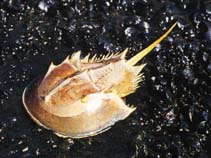
The males are approximately 1/3 the size of the females (sexual dimorphism) (Ref. 83). Minimum depth based from Ref. 76. Lives in shallow waters, with sandy or muddy bottoms (Ref. 76). Found in intertidal and offshore areas (Ref. 1131). The horseshoe crab feeds at night on polychaete worms such as Cerebratulus, Nereis, and Cistenides (Ref. 76, 77), small mollusks, and seaweed (algae) found in the sandy ocean bottom (Ref. 76). Food is picked up by the chelicerae and passed back to the bristle bases, where it is "chewed." The food is then moved forward to the mouth (Ref. 75). It digs its food from sediments, grasping the prey with its legs. The prey is moved to the gnathobases where it is crushed before being pushed forward toward the mouth (Ref. 77). A life span of about 20 to 40 years (Ref. 78). Its predators are loggerhead turtles, pufferfish, leopard sharks and sea gulls (Ref. 82).
Жизненный цикл и брачное поведение
половая зрелость | размножение | нерест | икра | Плодовитость | личинки
They reproduce with the use of the first pair of the six, flap-like appendages on the underside of the abdomen acts as a cover for the genital pore. The egg or sperm are released through this pore during spawning (Ref. 75). These eggs are fertilized by sperm released by an attached male and by one or more satellite males that typically congregate around the nesting pair (Ref. 81). While nesting, females bury themselves in the sediment near the water's edge and lay a series of discrete egg clusters, each containing 2,000-20,000 eggs (Ref. 80).
Основная ссылка
ссылки | координатор | соавторы
Lee, C.N. and B. Morton 2005 Experimentally derived estimates of growth by juvenile Tachypleus tridentatus and Carcinoscorpius rotundicauda (Xiphosura) from nursery beaches in Hongkong. Journal of Experimental Marine Biology and Ecology 318:39-49. (ссылка 1131)
Статус Красного Списка МСОП
(ссылка 130435: Version 2025-2 (Global))
Статус СИТЕС (ссылка 108899)
Not Evaluated
CMS (ссылка 116361)
Not Evaluated
Угроза для людей
Harmless
Использование человеком
рыболовство: коммерческий
FAO - рыболовство: посадки | FIRMS (Stock assessments) | FishSource | Море вокруг нас
инструменты
дополнительная информация
Динамика численности населения ФизиологияПотребление кислорода
Связанные с человекомМарки, монеты и прочее.
Информационно-просветительская работа
ресурсы в Интернет
Оценки, основанные на моделях
Предпочтительная температура
(Ref.
115969): 12.5 - 28, mean 26.7 (based on 417 cells).
Уязвимость рыбной ловли
High to very high vulnerability (66 of 100).
Климатическая уязвимость
High to very high vulnerability (75 of 100).
Nutrients : Calcium = 126 [75, 177] mg/100g; Iron = 4.79 [1.67, 7.92] mg/100g; Protein = 16.6 [15.4, 17.8] %; Omega3 = 0.331 [0.263, 0.400] g/100g; Selenium = 57.8 [48.5, 67.2] μg/100g; VitaminA = 0 μg/100g; Zinc = 1.97 [0.92, 3.02] mg/100g (wet weight); based on
nutrient studies.