Malacostraca |
Decapoda |
Raninidae
Environnement : milieu / zone climatique / profondeur / gamme de distribution
Écologie
Récifal; profondeur 1 - 200 m (Réf. 343). Tropical; 35°N - 34°S, 29°E - 139°W
Indo-Pacific: From East Africa, Japan to Australia and Hawaii.
Longueur à la première maturité / Taille / Poids / Âge
Maturité: Lm 7.2 range ? - 6.19 cm Max length : 17.5 cm CL mâle / non sexé; (Réf. 343); 12 cm CL (female); poids max. publié: 900.00 g (Réf. 343); poids max. publié: 900.00 g
Description synthétique
Morphologie
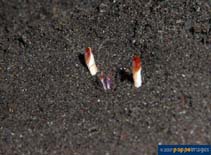
Carapace very elongate, much longer than broad; anterior part much broader than narrow, posterior waist-like. Abdomen clearly visible from dorsal view. Chelae greatly outsized in males; chelae and legs laterally flattened, spade-like. Color: orange to red overall.
Minimum depth from Ref. 114541. Maximum length (umsexed) from Ref. 85185. Occupies the sublittoral zone (Ref. 77016). Occurs at depths greater than 100 m in open sandy areas (Ref. 343) in which they bury (Ref. 106934). Feeds on a variety of worms and soft shelled mollusks (Ref. 343).
Members of the order Decapoda are mostly gonochoric. Mating behavior: Precopulatory courtship ritual is common (through olfactory and tactile cues); usually indirect sperm transfer.
Ng, P.K.L. 1998 Crabs. p. 1045-1155. In K.E. Carpenter and V.H. Niem (eds) FAO species identification guide for fishery purposes. The living marine resources of the Western Central Pacific. Volume 2. Cephalopods, crustaceans, holothurians and sharks. Rome, FAO. 1998. pp. 687-1396. (Réf. 343)
Statut dans la liste rouge de l'IUCN
(Réf. 130435: Version 2025-2 (Global))
statut CITES (Réf. 108899)
Not Evaluated
Not Evaluated
Menace pour l'homme
Utilisations par l'homme
Pêcheries: commercial
| FishSource | Sea Around Us
Outils
Plus d'informations
Dynamique des populations PhysiologieConsommation d'oxygène
Liées à l'hommeTimbres, pièces de monnaie, divers
Sources Internet
Estimations basées sur des modèles
Température préférée
(Ref.
115969): 18.2 - 28.8, mean 27.4 (based on 1084 cells).
Résilience
Milieu, temps minimum de doublement de population : 1,4 à 4,4 années (K=0.12-0.24).
Prior r = 0.93, 95% CL = 0.61 - 1.40, Based on 2 data-limited stock assessments.
Vulnérabilité de la pêche
Low vulnerability (24 of 100).
Catégorie de prix
Unknown.
Nutrients : Calcium = 109 [35, 184] mg/100g; Iron = 1.59 [1.21, 1.97] mg/100g; Protein = 20.2 [19.2, 21.3] %; Omega3 = 0.285 [0.185, 0.386] g/100g; Selenium = 48.3 [-31.7, 128.3] μg/100g; VitaminA = 0 μg/100g; Zinc = 1.79 [1.17, 2.40] mg/100g (wet weight); based on
nutrient studies.