Scyphozoa |
Rhizostomeae |
Lychnorhizidae
Meio ambiente: milieu / Zona climática / intervalo de profundidade / faixa de distribuição
Ecologia
Pelágico(a,os,as). Tropical
Pacific Ocean.
Comprimento de primeira maturação / Tamanho / Peso / Idade
Maturidade: Lm ? range ? - ? cm Max length : 60.0 cm WD macho/indeterminado; (Ref. 2992)
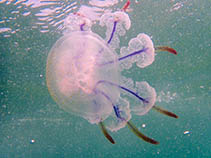
60 cm wide, flat, exumbrella with low, wart like projections in central part; in each octant six velar lappets, slightly convex, the two lateral smaller; mouth-arms branched only near the tip, the entire outer surface quite bare; mouths surrounded by tiny filaments; near center of disk very small, slender filaments; each arm terminates in a long, slender club; inter-rhopalar canals end at ring canal; between the 26 radial canals only one intracircular canal.
Ciclo de vida ou comportamento de acasalamento
Maturidade | Reprodução | Desova | Ovos | Fecundidade | Larvas
Members of the class Scyphozoa are gonochoric. Life cycle: Egg is laid by the adult medusa which later develops into a free-living planula, then to a scyphistoma to a strobila, and lastly to a free-living young medusa.
Kramp, P.L. 1961 Synopsis of the medusae of the world. J Mar Biol Ass UK 40:1-469. (Ref. 2992)
Status na Lista Vermelha da UICN
(Ref. 130435: Version 2025-2 (Global))
Status no CITES (Ref. 108899)
Not Evaluated
Not Evaluated
Ameaça para os humanos
Uso pelos humanos
| FishSource |
Ferramentas
Mais informação
Ecologia TróficaItens alimentares (presas)
Composição da dieta
Consumo alimentar
Predadores
Dinâmica populacionalCrescimento
Idade máxima / tamanhos
Relação comprimento-peso.
Relação comprimento-comprimento.
Frequências de comprimento
Conversão de massa
Abundância
Ciclo de vidaReproduçãoMaturidadeFecundidadeDesovaOvosDesenvolvimento dos ovosLarvas FisiologiaConsumo de oxigênio
Relacionado a humanosSelos, moedas, diversos.
Fontes da internet
Estimativas baseadas em modelos
Vulnerabilidade da pesca
Moderate vulnerability (44 of 100).
Categoria de preço
Unknown.