Hexacorallia |
Scleractinia |
Merulinidae
Environment: milieu / climate zone / depth range / distribution range
Ecology
Reef-associated; depth range 0 - 40 m (Ref. 848). Tropical; 22°N - 31°S, 95°E - 174°E (Ref. 848)
Indo-West Pacific.
Length at first maturity / Size / Weight / Age
Maturity: Lm ? range ? - ? cm
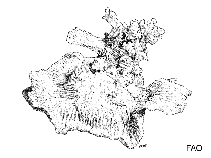
Colony: submassive to encrusting, often up to 1 m across. Corallites: crowded, until 20 mm diameter, with low walls. Common extratentacular budding. Uniform septo-costae, not exsert. Septa with fine teeth. Inconspicuous paliform lobes. Color: distinct pinkish-brown with darker corallite inner walls and pale oral discs (Ref. 848).
Occurs in shallow reef slopes (Ref. 848).
Life cycle and mating behavior
Maturity | Reproduction | Spawning | Eggs | Fecundity | Larvae
Members of the class Anthozoa are either gonochoric or hermaphroditic. Mature gametes are shed into the coelenteron and spawned through the mouth. Life cycle: The zygote develops into a planktonic planula larva. Metamorphosis begins with early morphogenesis of tentacles, septa and pharynx before larval settlement on the aboral end.
Veron, J.E.N. 2000 Corals of the world. Volume 3. Australian Institute of Marine Science and CRR Qld. Pty. Ltd. Australia. 490 p. (Ref. 848)
IUCN Red List Status
(Ref. 130435: Version 2025-2 (Global))
CITES status (Ref. 108899)
Not Evaluated
Threat to humans
Human uses
| FishSource |
Tools
More information
Trophic EcologyFood items (preys)
Diet composition
Food consumption
Predators
Population dynamicsGrowth
Max. ages / sizes
Length-weight rel.
Length-length rel.
Length-frequencies
Mass conversion
Abundance
Life cycleReproductionMaturityFecunditySpawningEggsEgg developmentLarvae PhysiologyOxygen consumption
Human RelatedStamps, coins, misc.
Internet sources
Estimates based on models
Preferred temperature
(Ref.
115969): 24.9 - 28, mean 27.1 (based on 132 cells).
Price category
Unknown.