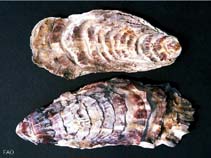
Bivalvia |
Ostreida |
Ostreidae
Environnement : milieu / zone climatique / profondeur / gamme de distribution
Écologie
Benthic; saumâtre; profondeur 0 - 15 m (Réf. 348). Subtropical; 15°C - 30°C (Réf. 76803), preferred 13°C (Réf. 107945); 62°N - 21°N, 113°E - 174°E
Northwest Pacific: from Hong Kong, east to Taiwan, and north to Kamchatka, Russia. Introduced in the rest of the Pacific, Atlantic, Indian Ocean and the Mediterranean.
Longueur à la première maturité / Taille / Poids / Âge
Maturité: Lm ? range ? - ? cm Max length : 45.0 cm SHL mâle / non sexé; (Réf. 348); common length : 15.0 cm SHL mâle / non sexé; (Réf. 348)
A major commercial species. Introduced for aquaculture in many countries. However experimental plantings in tropical western Pacific Islands often failed, apparently because of the sustained high temperature of the water (Ref. 348). Littoral and circalittoral rock and other hard substrata as well as littoral and sublittoral sediments (Ref. 1314). It is a sessile-burrower, suspension feeder (Ref. 96498).
Cycle de vie et comportement reproducteur
Maturité | Reproduction | Frai | Œufs | Fécondité | Larves
Poutiers, J.M. 1998 Bivalves. Acephala, Lamellibranchia, Pelecypoda. p. 123-362. In Carpenter, K. E. and V. H. Niem. 1998. FAO species identification guide for fishery purposes. The living marine resources of the Western Central Pacific. Volume 1. Seaweeds, corals, bivalves, and gastropods. Rome, FAO. (Réf. 348)
Statut dans la liste rouge de l'IUCN
(Réf. 130435: Version 2025-2 (Global))
statut CITES (Réf. 108899)
Not Evaluated
Not Evaluated
Menace pour l'homme
Utilisations par l'homme
Pêcheries: commercial
FAO - Aquaculture: production, Résumé espèce; pêcheries: débarquements, Résumé espèce | FishSource | Sea Around Us
Outils
Plus d'informations
Dynamique des populations Cycle de vieReproduction
Maturité
Fécondité
Frai
Œufs
Développement de l'œuf
Larves
PhysiologieConsommation d'oxygène
Liées à l'hommeTimbres, pièces de monnaie, divers
Sources Internet
Estimations basées sur des modèles
Température préférée
(Ref.
115969): 7.4 - 22.6, mean 16 (based on 334 cells).
Résilience
Haut, temps minimum de doublement de population inférieur à 15 mois (K=0.01-2.69).
Prior r = 0.57, 95% CL = 0.37 - 0.85, Based on 3 data-limited stock assessments.
Vulnérabilité de la pêche
Low vulnerability (23 of 100).
Vulnérabilité climatique
Moderate to high vulnerability (55 of 100).
Nutrients : Calcium = 149 [71, 228] mg/100g; Iron = 8.53 [1.95, 15.11] mg/100g; Protein = 9.88 [8.64, 11.12] %; Omega3 = 0.313 [0.202, 0.423] g/100g; Selenium = 61 [50, 72] μg/100g; VitaminA = 0 μg/100g; Zinc = 2.04 [0.56, 3.51] mg/100g (wet weight); based on
nutrient studies.