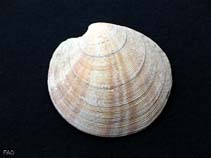
Bivalvia |
Venerida |
Veneridae
Milieu: milieu / Klimaatzone / Diepte / verspreidingsgebied
Ecologie
Benthic; diepte 0 - 150 m (Ref. 114594). Subtropical; 69°N - 5°S, 26°W - 37°E (Ref. 78075)
Eastern Atlantic and the Mediterranean.
Lengte bij maturiteit / Grootte / Gewicht / Leeftijd
Maturiteit: Lm ? range ? - ? cm Max length : 4.6 cm SHL mannelijk / geslacht onbekend; (Ref. 2758)
Minimum depth based on occurrence (Ref. 2758, p. 805); to be replaced with better reference. Exists in a front (Ref. 122116). Inhabits coarse sands and fine gravels (Ref. 2780). Burrows deeply in sand, mud and gravel bottoms from intertidal to a depth of 70 m (Ref. 114594). Also found in Zostera marina bed (Ref. 122139). An active suspension feeder (Ref. 96376).
Levenscyclus en paargedrag
Maturiteit | Voortplanting | Paaien | Eieren | Fecunditeit | Larven
Members of the class Bivalvia are mostly gonochoric, some are protandric hermaphrodites. Life cycle: Embryos develop into free-swimming trocophore larvae, succeeded by the bivalve veliger, resembling a miniature clam.
Gaspar, M.B., M.N. Santos, P. Vasconcelos and C.C. Monteiro 2002 Shell mophometric relationships of the most common bivalve species (Mollusca: Bivalvia) of the Algarve coast (southern Portugal). Hydrobiologia 477:73-80. (Ref. 2736)
Status op de Rode Lijst van het IUCN
(Ref. 130435: Version 2025-2 (Global))
CITES status (Ref. 108899)
Not Evaluated
Not Evaluated
Gevaar voor de mens
Gebruik door de mens
Visserij: commercieel
| FishSource |
Tools
Meer informatie
LevenscyclusVoortplantingMaturiteitFecunditeitPaaienEierenOntwikkeling van de eierenLarven FysiologieZuurstofverbruik
Menselijk gerelateerdPostzegels, munten, diversen.
Internetbronnen
Schattingen op basis van modellen
Gewenste temperatuur
(Ref.
115969): 9.7 - 20, mean 12.5 (based on 525 cells).
Kwetsbaarheid van de visserij
Low vulnerability (10 of 100).