Echinoidea |
Diadematoida |
Diadematidae
Environnement : milieu / zone climatique / profondeur / gamme de distribution
Écologie
Récifal; profondeur 0 - 400 m (Réf. 98615). Tropical
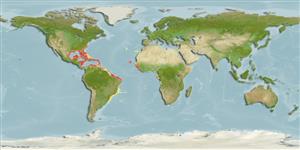
Central Atlantic: Gulf of Mexico, Caribbean south to Brazil and into eastern Atlantic, Canary Island.
Longueur à la première maturité / Taille / Poids / Âge
Maturité: Lm ? range ? - ? cm
Known to be rare at greater depths (Ref. 86574). Minimum depth from Ref. 83942. This is an epibenthic, subtidal species found in coral reefs and rocky bottoms (Ref. 83942). On coral reefs to a depth of 50 m, but common in shallow water (Ref. 415, 86574); and on Thalassia sp. beds (Ref. 86574). Nocturnal grazers (Ref. 415).
Cycle de vie et comportement reproducteur
Maturité | Reproduction | Frai | Œufs | Fécondité | Larves
Spawning occurs during full moon (Ref. 98615).
Collin, R., M.C. Díaz, J. Norenburg, R.M. Rocha, J.A. Sánchez, M. Schulze, A. Schwartz and A. Valdés 2005 Photographic identification guide to some common marine invertebrates of Bocas Del Toro, Panama. Caribbean Journal of Science. 41(3):638-707. (Réf. 415)
Statut dans la liste rouge de l'IUCN
(Réf. 130435: Version 2025-2 (Global))
statut CITES (Réf. 108899)
Not Evaluated
Not Evaluated
Menace pour l'homme
Utilisations par l'homme
| FishSource |
Outils
Plus d'informations
Dynamique des populationsCroissanceÂges / tailles maximalesLongueur-poids rel.Rel. longueur-longueur.Fréquences de longueursConversion de masseAbondance PhysiologieConsommation d'oxygène
Liées à l'hommeTimbres, pièces de monnaie, divers
Sources Internet
Estimations basées sur des modèles
Température préférée
(Ref.
115969): 17.1 - 27.1, mean 23.3 (based on 157 cells).
Catégorie de prix
Unknown.