Pycnogonida |
Pantopoda |
Phoxichilidiidae
Ambiente: milieu / zona climatica / distribuzione batimetrica / gamma di distribuzione
Ecologia
Benthic; distribuzione batimetrica 0 - 576 m (Fonte Biblio. 116112). Subtropical
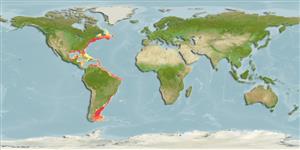
Western Atlantic: Leeward Islands, Trinidad, Colombia and USA.
Lunghezza alla prima maturità / Dimensione / Peso / Età
Maturità: Lm ? range ? - ? cm
Trunk fully segmented, without tubercles or setae; lateral processes well separated, twice longer than their diameters. Neck short; ocular tubercle low, with small apical cone; eyes distal, well pigmented. Proboscis large, cylindrical, swollen distally, without ventral tubercles in female. Abdomen short, erect, glabrous. Chelifores large, setose distally; chelae long; fingers banana-shaped, very setose. Ovigers long; third segment almost twice length of second; terminal segments very setose. Legs very long, slender, with many short setae; cement gland a very long slit in dorsum of femur; propodus with rounded tubercle distally, three large heel spines, and sole without lamina; claw fairly short, with tiny auxiliaries (Ref. 2115, p. 51)
Shelf to slope (Ref. 19); intertidal to at least 576 m (Ref. 2115, page 52). Epibiotic (Ref. 116112).
Ciclo vitale e comportamento di accoppiamento
Maturità | Riproduzione | Deposizione | Uova | Fecondità | Larve
Reproduction: reproduces towards the end of August on coasts of North America (Ref. 227).
Child, C.A. 1992 Shallow-water Pycnogonida of Gulf of Mexico. Memoirs of the Hourglass Cruises 9:1-86. Florida Department Natural Resources, Bureau of Marine Resources, Jan. 1992. (Fonte Biblio. 2115)
Stato della Lista Rossa IUCN
(Fonte Biblio. 130435: Version 2025-2 (Global))
Stato della CITES (Fonte Biblio. 108899)
Not Evaluated
CMS (Fonte Biblio. 116361)
Not Evaluated
Minaccia per l'uomo
Usi umani
| FishSource |
Strumenti
Informazioni ulteriori
Dinamica della popolazioneAccrescimento
Età massima / dimensioni massime
Rapporto lunghezza-peso.
Lunghezza-lunghezza rel.
Lunghezza-frequenze
Conversione di massa
Abbondanza
Ciclo di vitaRiproduzioneMaturitàFeconditàDeposizioneUovaSviluppo delle uovaLarve FisiologiaConsumo di ossigeno
Legato all'uomoFrancobolli, monete, materiale vario.
Fonti Internet
Stime basate su modelli
Temperatura preferita
(Ref.
115969): 13 - 27.9, mean 26.7 (based on 546 cells).
Categoria di prezzo
Unknown.