Pycnogonida |
Pantopoda |
Colossendeidae
Environnement : milieu / zone climatique / profondeur / gamme de distribution
Écologie
Benthic; profondeur 0 - 3610 m (Réf. 1680). Polar
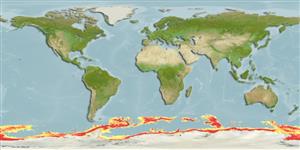
Antarctic and Pacific.
Longueur à la première maturité / Taille / Poids / Âge
Maturité: Lm ? range ? - ? cm
Continental rise, continental shelf, continental slope, intertidal (Ref. 1456); Coastal to abyssal (Ref. 19). Found to feed exclusively on hydroids (Ref. 121217).
Cycle de vie et comportement reproducteur
Maturité | Reproduction | Frai | Œufs | Fécondité | Larves
Members of the class Pycnogonida are gonochoric and sexually dimorphic. During copulation, male usually suspends itself beneath the female. Fertilization occurs as the eggs leave the female's ovigers. Males brood the egg masses until they hatch. Life cycle: Eggs hatch into protonymphon larva then to adults.
León, T.M. 2001 A new species of Ammothea (Pycnogonida) and other pycnogonids from Livingston Island and surrounding waters (South Shetland Islands, Antarctica). Antarc. Sci. 13 (2):144-149. (Réf. 1669)
Statut dans la liste rouge de l'IUCN
(Réf. 130435: Version 2025-2 (Global))
statut CITES (Réf. 108899)
Not Evaluated
Not Evaluated
Menace pour l'homme
Harmless
Utilisations par l'homme
| FishSource |
Outils
Plus d'informations
Dynamique des populationsCroissance
Âges / tailles maximales
Longueur-poids rel.
Rel. longueur-longueur.
Fréquences de longueurs
Conversion de masse
Abondance
Cycle de vieReproductionMaturitéFéconditéFraiŒufsDéveloppement de l'œufLarves PhysiologieConsommation d'oxygène
Liées à l'hommeTimbres, pièces de monnaie, divers
Sources Internet
Estimations basées sur des modèles
Température préférée
(Ref.
115969): -1.9 - 1.7, mean 0.4 (based on 1300 cells).
Catégorie de prix
Unknown.