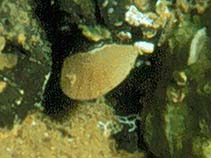
Articulata |
Terebratulida |
Megathyrididae
Meio ambiente: milieu / Zona climática / intervalo de profundidade / faixa de distribuição
Ecologia
Benthic; intervalo de profundidade 15 - 51 m (Ref. 1023). Temperate
Mediterranean: Greece. Northeast Atlantic.
Comprimento de primeira maturação / Tamanho / Peso / Idade
Maturidade: Lm ? range ? - ? cm
Minimum depth based on Ref. 2672. Preferred substrate; pedicle attachment to cave walls and roofs; boulders, coralligéne; shallow; infralittoral-circa littoral (Ref. 1884).
Ciclo de vida ou comportamento de acasalamento
Maturidade | Reprodução | Desova | Ovos | Fecundidade | Larvas
Members of the phylum Brachiopoda are gonochoric. Eggs are shed into the water and fertilized at the time of spawning. Life cycle: Eggs develop into free-swimming larvae which later metamorphose into adult.
Hansson, H.G. 1998 NEAT (North East Atlantic Taxa): South Scandinavian Marine "Lophophorata" Check-list compiled at TMBL (Tjärnö Marine Biological Laboratory). NEAT (North East Atlantic Taxa): South Scandinavian marine "Lophophorata" Check-List. Internet pdf Ed., Feb. 1999. [http://www.tmbl.gu.se]. (Ref. 1023)
Status na Lista Vermelha da UICN
(Ref. 130435: Version 2025-2 (Global))
Status no CITES (Ref. 108899)
Not Evaluated
Not Evaluated
Ameaça para os humanos
Uso pelos humanos
| FishSource |
Ferramentas
Mais informação
Ecologia TróficaItens alimentares (presas)
Composição da dieta
Consumo alimentar
Predadores
Dinâmica populacionalCrescimento
Idade máxima / tamanhos
Relação comprimento-peso.
Relação comprimento-comprimento.
Frequências de comprimento
Conversão de massa
Abundância
Ciclo de vidaReproduçãoMaturidadeFecundidadeDesovaOvosDesenvolvimento dos ovosLarvas FisiologiaConsumo de oxigênio
Relacionado a humanosSelos, moedas, diversos.
Fontes da internet
Estimativas baseadas em modelos
Categoria de preço
Unknown.