Not assigned |
Testudines |
Cheloniidae
Environment: milieu / climate zone / depth range / distribution range
Ecology
Pelagic; depth range 0 - 200 m (Ref. 417). Tropical; 61°N - 53°S, 180°W - 180°W
Circumglobal.
Length at first maturity / Size / Weight / Age
Maturity: Lm ?, range 88 - 99 cm Max length : 105 cm CL male/unsexed; (Ref. 417); common length : 90.0 cm CL male/unsexed; (Ref. 417); max. published weight: 386.4 kg (Ref. 138263)
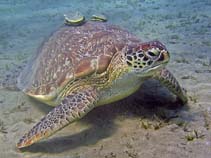
In adults, body is depressed and carapace is oval in dorsal view, its width about 88% of its length. Head small and blunt; one pair of elongated prefrontal scales between the orbits; tomium of lower jaw with a sharply serrated which loses its tip cusp with age. Cutting rim corresponds with strong ridges on the inner surface of the upper. Carapacial scutes: thin, smooth and flexible when removed. The dorsal side have 4 pairs of lateral scutes, the foremost not touching the precentral scute; 5 central scutes, low-keeled in
juveniles. In subadults and adults, it lacks a median keeand have 12 pairs of marginal scutes. On the underside, the scutes are smooth and thin with 4 pairs of inframarginal, 12 pairs of central plastral; one intergular and sometimes one interanal scute in shape. Each flipper has a single, visible claw. Color: On the upper side, varies from pale to very dark and from plain colour to brilliant combinations of yellow, brown and greenish tones, forming radiated stripes, or abundantly splattered with dark blotches. In juveniles, the scales of the head and upper sides of the flippers are fringed by a narrow, clear, yellowish margin which is usually lost with age. Underneath, the Atlantic forms are plain white, dirty white or yellowish white; the Pacific forms are a dark greybluish-green. Newborn hatchlings are dark brown or nearly black on the upper side; carapace and the rear edges of the flippers with a white margin. Underneath they are white.
The total catches in 1987 are: 864 metric tons for FAO area 77 and 305 metric tons for FAO area 87 (Ref. 1397). Exploited for their eggs, shell, and flesh that are used for food and medicinal purposes (Ref. 85371). Considered to be the best species for commercial ranching or farming but capturing green turtles was forbidden; although for some areas, it still persists. Inadvertently caught in trawls (Ref. 1397). This species is not at risk of global extinction, rather subpopulations in different areas may become extinct if not dealt with, thus regional population listings are important for better conservation assessments (Ref. 83887). A typical solitary nektonic animal which usually feeds at shallow water areas where seagrasses or algae is abundant (Ref. 417). Feeds on algae and seagrasses (Ref. 97534). Home ranges for individuals feeding on algae is larger than individuals feeding on seagrass (Ref. 66638). Adults are known to be herbivorous while hatchlings to juvenile sizes are assumed to be carnivorous which has faster growth rates. When they get big enough, mostly capable of avoiding predators, they shift to a herbivorous diet (Ref. 417). Adults spend their adult life in foraging grounds which is often in great distance from nesting grounds (Ref. 66637). This results in a great energy cost from transport and fasting during the travel, thus females are observed to rest on the sea floor between nestings (Ref. 85359). Since mating occurs at sea, courting and copulation behavior are observed near nesting beaches and males are described to display and elaborate courtship behavior (Ref. 66637). In Hawaii beach-basking behavior was observed to facilitate temperature regulation (Ref. 81046). They have a swimming speed of 32km/hr (Ref. 83508). During nesting, females emerge from the water and creates a set of tracks one ascending to a successful nest or aborted digging while another extends as it descends to the sea (Ref. 83891). Post-nesting behavior shows a dominance of short dives mainly during open-ocean migration. This aids them in lessening their energy cost during transport, plus there is little food available in the open-ocean thus close to surface dives is observed. They also combine open-ocean and coastal routes for provision of foraging opportunities (Ref. 83560). Couplings of water temperature and their behavior is observed among this species (Ref. 85360).
Gonochorism. Two year breeding interval; can also breed in cycles of 1, 3 or 4 years or may switch from one cycle to another depending on age, food quantity and quality. Usually successive nestings are separated by two week intervals, which often lays 2 to 5 clutches per season. Nesting peaks differs in response to variations in localities (Ref. 1397). Mating system of green turtles is called scramble polygamy, which is when males competitively search for receptive females. Individual males are thus observed to mate with several females within the same season (Ref. 66637). Their secondary sexual characteristic is a longer prehensile tail with terminal nail, larger, recurved claws on the front flippers and a soft, more concave plastra (Refs. 85357, 85358). This characteristic is important for successful mounting in the face of intrasexual agonism, which is common for this species (Ref. 85356). Sexual dimorphism also exists for this species, males being a smaller size and females being larger. This helps males be efficient at foraging, defending their territories, and performing elaborate courtship displays which is favored by females. The larger size of females on the other hand, favors them since it allows them to lay more large-sized eggs (Ref. 66637).
Hirth, H.F. 1993 Chapter 10. Marine turtles. pp. 329-370. In A. Wright and L. Hill (eds) Nearshore marine resources of the South Pacific. Forum Fisheries Agency (Honiara), Institute of Pacific Studies (Suva) and International Centre for Ocean Development (Canada), 710 p. (Ref. 97534)
IUCN Red List Status
(Ref. 130435: Version 2025-2 (Global))
CITES status (Ref. 108899)
Threat to humans
Human uses
Fisheries: commercial; aquarium: commercial
FAO - Aquaculture: production; Fisheries: landings, species profile | FishSource | Sea Around Us
Tools
More information
PhysiologyOxygen consumption
Human RelatedStamps, coins, misc.
Internet sources
Estimates based on models
Preferred temperature
(Ref.
115969): 15.7 - 28.9, mean 26.7 (based on 5784 cells).
Resilience
Low, minimum population doubling time 4.5 - 14 years (K=0.03-0.74; tm=29).
Fishing Vulnerability
High vulnerability (59 of 100).
Price category
Unknown.