Mammalia |
Cetartiodactyla |
Balaenopteridae
Environment: milieu / climate zone / depth range / distribution range
Ecology
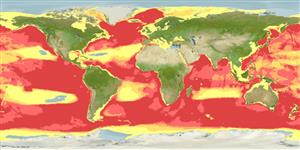
Pelagic; depth range 0 - 342 m (Ref. 116169). Tropical; 8°C - 25°C (Ref. 75906); 90°N - 90°S, 180°W - 180°E
Circumglobal: Balaenoptera borealis borealis: Greenland, Iceland, Norway, North Carolina, Bay of Biscay, Mediterranean Sea, South Carolina, Gulf of Mexico, Bay of Campeche, Caribbean Sea, Cuba, Anguilla, Morocco, Mauritania, Alaska, Bering Sea, Gulf of Alaska, Japan, Southern California, Ogasawara, Mexico, Islas Revilla Gigedo (Pacific Ocean); Balaenoptera borealis schlegellii: Antarctica, Brazil, Angola, South Africa, Western Australia, Cook Straits, New Zealand, Peru, Java Indonesia (Ref. 1522).
Length at first maturity / Size / Weight / Age
Maturity: Lm 1,330.0 range ? - ? cm Max length : 1,800 cm TL male/unsexed; (Ref. 1394); max. published weight: 30.0 t (Ref. 1394)
Largest of the sei whales. As the larger rorquals became scarce in recent decades, hunting pressure on sei, Bryde’s, and minke whales increased, largely in the Antarctic. Although heavily depleted, sei whales have recovered somewhat more successfully from hunting than other large baleen whales (Ref. 1394). Generally found in coastal, shelf and oceanic waters (Ref. 122680). Feeds at the shelf break and seaward throughout the summer (Ref. 96832). Restricted to mid-latitude temperate zones (Ref. 1394). Uses both skimming and gulping as feeding strategies (Ref. 122680). Skims copepods and other small prey types (Ref. 1394); also feeds on squids (Ref. 122680), euphausiids and a variety of fish including saury and whiting. Also a "swallower." Zooplankton concentrations influence where the whales feed. Migratory (Ref. 96832). Commonly in groups of 2 to 5 individuals (Ref. 801).
Life cycle and mating behavior
Maturity | Reproduction | Spawning | Eggs | Fecundity | Larvae
Jefferson, T.A., S. Leatherwood and M.A. Webber 1993 FAO species Identification Guide: Marine Mammals of the World. Rome, FAO. 320 p. + 587 figures. (Ref. 1394)
IUCN Red List Status
(Ref. 130435: Version 2025-2 (Global))
CITES status (Ref. 108899)
Threat to humans
Human uses
Fisheries: commercial
FAO - Fisheries: landings, species profile | FishSource | Sea Around Us
Tools
More information
PhysiologyOxygen consumption
Human RelatedStamps, coins, misc.
Internet sources
Estimates based on models
Preferred temperature
(Ref.
115969): 0.2 - 3.1, mean 1.5 (based on 19380 cells).
Fishing Vulnerability
Very high vulnerability (90 of 100).
Price category
Unknown.