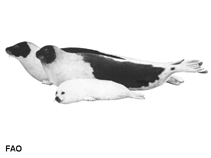
Mammalia |
Carnivora |
Phocidae
Milieu: milieu / Klimaatzone / Diepte / verspreidingsgebied
Ecologie
Bathydemersaal; diepte 0 - 6000 m (Ref. 356). Boreal; 90°N - 0°S, 97°W - 180°E
Atlantic Ocean and the Arctic: North Atlantic Ocean, Arctic Ocean, Baffin Island, Magdalen Island, Russia, Canada (Ref. 1394). Pagophilus groenlandicus groenlandicus: Newfoundland, Jan Mayen (Norway), Baffin Bay, Greenland Sea, Nova Scotia, Greenland, Iceland; and vagrants in Virginia, Scotland, Germany, France; Pagophilus groenlandicus oceanicus: Barents Sea, Russia, White Sea (Ref. 1522).
Lengte bij maturiteit / Grootte / Gewicht / Leeftijd
Maturiteit: Lm ? range ? - ? cm Max length : 190 cm TL mannelijk / geslacht onbekend; (Ref. 1394); 180 cm TL (female); max. gepubliceerd gewicht: 135.0 kg (Ref. 1394); max. gepubliceerd gewicht: 135.0 kg
Live chiefly in pack ice, but can be found away from it in summer. Feeds on a variety of crustaceans and open-water fishes during migration, and switch to several varieties of bottom dwelling fishes in summer on the northern grounds (Ref. 1394). Live chiefly in pack ice, but can be found away from it in summer (Ref. 1394). Adults are highly gregarious; young seals tend to be solitary. Typically forms aggregations when feeding (Ref. 117964). Feeds on a variety of crustaceans and open-water fishes during migration, and switch to several varieties of bottom dwelling fishes in summer on the northern grounds (Ref. 1394).
Levenscyclus en paargedrag
Maturiteit | Voortplanting | Paaien | Eieren | Fecunditeit | Larven
Jefferson, T.A., S. Leatherwood and M.A. Webber 1993 FAO species Identification Guide: Marine Mammals of the World. Rome, FAO. 320 p. + 587 figures. (Ref. 1394)
Status op de Rode Lijst van het IUCN
(Ref. 130435: Version 2025-2 (Global))
CITES status (Ref. 108899)
Not Evaluated
Not Evaluated
Gevaar voor de mens
Gebruik door de mens
Visserij: commercieel
FAO - visserij: aanvoer, soortsprofiel | FIRMS (Stock assessments) | FishSource | Sea Around Us
Tools
Meer informatie
LevenscyclusVoortplanting
Maturiteit
Fecunditeit
Paaien
Eieren
Ontwikkeling van de eieren
Larven
FysiologieZuurstofverbruik
Menselijk gerelateerdPostzegels, munten, diversen.
Internetbronnen
Schattingen op basis van modellen
Gewenste temperatuur
(Ref.
115969): -0.9 - 4.1, mean 0.6 (based on 2101 cells).
Kwetsbaarheid van de visserij
High to very high vulnerability (71 of 100).
Prijsklasse
Unknown.